
Oriental mole cricket
Gryllotalpa orientalis
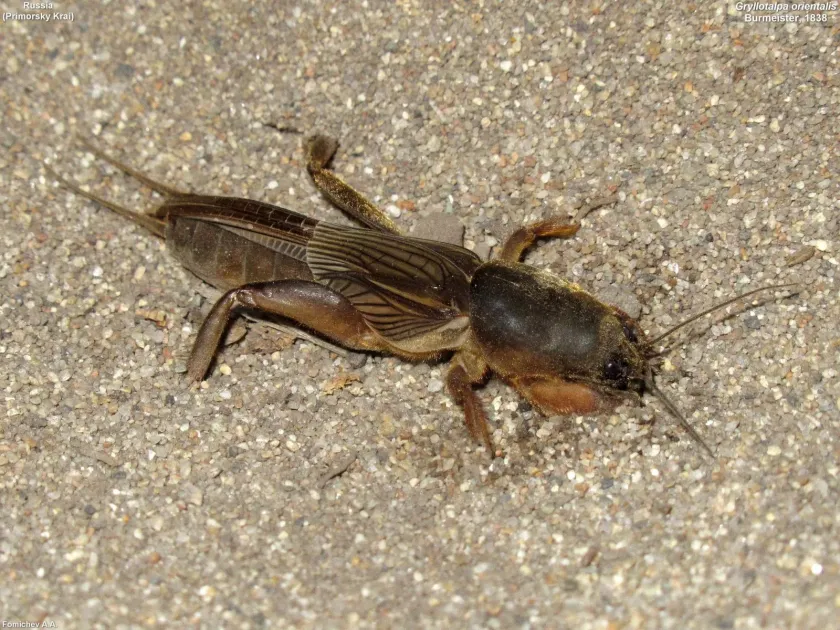
Description
How to identify
The Oriental mole cricket (Gryllotalpa orientalis) is a significant soil-dwelling pest belonging to the order Orthoptera and the Gryllotalpidae family.
Adult insects typically measure about 40–50 mm in length and possess a dark brown, robust body covered with dense sensory hairs, which aids in navigating underground.
The most striking morphological feature is the pair of heavily sclerotized, shovel-like front legs designed for excavating soil and cutting through subterranean roots.
Adults possess functional wings, which allow them to fly during mating seasons, enabling them to migrate between fields and infest new areas of land.
Nymphs resemble smaller, wingless versions of the adults. Despite their smaller size, they are equally destructive and actively forage for food in the upper soil layers.
What it damages
Oriental mole crickets are highly polyphagous, meaning they feed on a wide range of plants, causing substantial economic losses in agriculture and home gardening.
They are notorious for cutting through the stems of young seedlings, such as tomatoes, peppers, and eggplants, often leading to rapid plant death in vegetable beds.
Root crops including potatoes, carrots, and sweet potatoes are frequently damaged by deep tunnels bored by the crickets, which reduces both quality and yield.
Young germinating seeds of cereal crops like corn and wheat are often consumed entirely, resulting in poor stand establishment and requiring expensive replanting.
Furthermore, their tunneling activity disrupts the soil structure and exposes delicate root systems to dry out, making plants more susceptible to environmental stress.
When it appears
Activity typically resumes in early spring when the soil temperature at a depth of 10–20 cm rises, signaling the end of the winter dormancy period.
Spring months are critical, as adults emerge from overwintering sites in search of food and appropriate locations to construct egg-laying chambers.
During the summer months, activity levels may vary with moisture content; these crickets thrive in moist, loose soils and may burrow deeper during hot, dry spells.
As temperatures drop in autumn, the mole crickets gradually retreat to deeper soil strata to survive the cold, often settling below the frost line.
The total life cycle duration is heavily influenced by the local climate, typically spanning one to two years before an individual reaches the adult reproductive stage.
Signs of infestation
A primary indicator of infestation is the presence of winding, raised ridges on the soil surface, especially visible following irrigation or rainfall events.
The sudden wilting and collapse of healthy-looking seedlings indicate that roots have been severed below the surface, a hallmark sign of mole cricket feeding.
Circular exit and entry holes, measuring about 1–2 cm in diameter, scattered across the garden soil serve as evidence of their tunneling activities.
Patches of sparse or missing plants within crop rows, where seeds or roots were destroyed before emergence, clearly signal the presence of the pest.
When digging, finding irregular subterranean chambers packed with debris or abandoned egg clutches confirms that the area is an active nesting site.
Control measures
Successful management of the Oriental mole cricket requires an integrated strategy, as no single method provides complete control against established populations.
Cultural practices like deep autumn plowing are essential, as this physically disturbs nesting sites and exposes larvae and adults to predators and adverse weather.
Trapping techniques, such as using containers or moist manure piles to attract the crickets, are effective in small gardens to reduce immediate populations.
Chemical control involves the application of targeted insecticide baits containing ingredients like fipronil, placed directly into the soil near affected plants.
Biological control using entomopathogenic nematodes or fungi, such as Beauveria bassiana, provides an environmentally friendly alternative to traditional pesticides.
Taxonomy
- Latin name
- Gryllotalpa orientalis
- Order
- Orthoptera (locusts)
- Family
- Gryllotalpidae
- EPPO code
- GRYTOR
Discussion
No discussions yet — be the first.