
Diurnea fagella
Diurnea
Description
How to identify
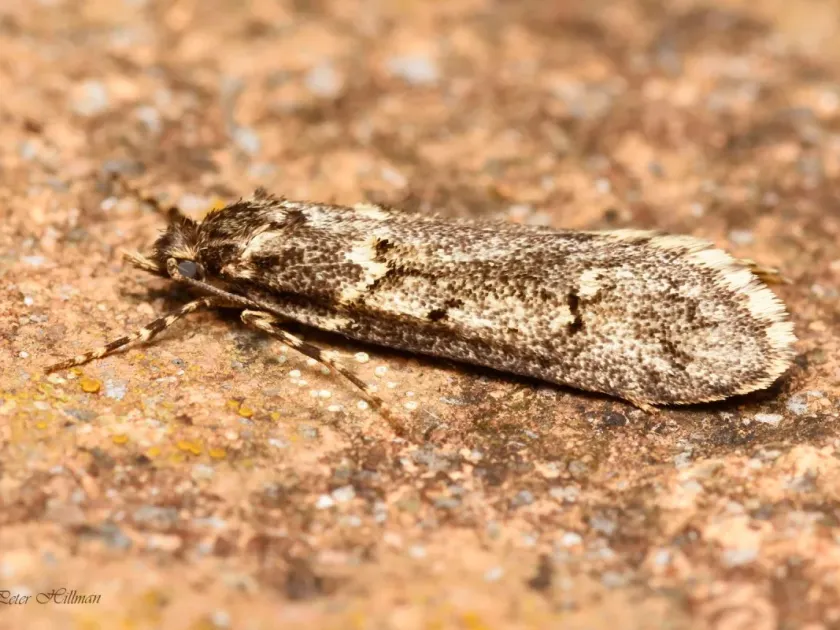
Diurnea fagella, commonly known as the November Moth or Northern Winter Moth (though often referred to in agricultural contexts as a leaf-roller), belongs to the family Chimabachidae. This moth exhibits significant sexual dimorphism, which is a key factor in its biology.
The adult males have fully developed wings with a span of approximately 25–30 mm, displaying a mottled greyish-brown pattern that provides excellent camouflage on tree bark. They are strong fliers and are attracted to light.
In contrast, the females have vestigial, rudimentary wings, rendering them flightless. They are forced to crawl up the trunks of trees to reach the foliage and laying sites, a behavioral trait that is exploited in control strategies.
The larvae are typically greenish with a darker head capsule. They go through several instars, growing significantly in size and becoming more destructive as they approach pupation.
This insect is widely distributed across temperate regions and is commonly found in deciduous woodlands, parks, and suburban gardens where it interacts with various tree species.
What it damages
Diurnea fagella is a polyphagous pest, meaning it feeds on a wide range of host plants. It is frequently associated with deciduous trees such as oak, beech, lime, and birch, but often spreads to commercial orchards.
In agricultural settings, it can cause economic damage to apple, pear, and cherry trees. The larvae feed on leaves, leading to severe defoliation if populations are left unchecked.
By skeletonizing the leaves, the larvae reduce the photosynthetic capacity of the tree, which directly impacts the growth rate and overall vigor of the host plant during the critical spring period.
The impact is particularly notable in young nurseries or orchards, where the loss of leaf area can stunt the development of saplings and reduce the yield potential for future seasons.
While often considered a secondary pest compared to other leaf-rollers, its ability to coexist with other species can lead to a cumulative stress effect on the trees, weakening them against secondary infections.
When it appears
The life cycle of this species is uniquely early in the season. Unlike many other lepidopterans, the adults emerge very early, typically between March and April, often when temperatures are still quite cool.
Mating occurs shortly after emergence. The flightless females crawl up the tree trunks to deposit eggs in crevices, near buds, or in the forks of branches, effectively positioning the next generation for the upcoming bud break.
Larval emergence is synchronized with the phenology of the host plants, ensuring that neonate larvae have access to nutritious, tender leaf tissue as soon as it unfolds from the buds.
The larvae feed throughout the late spring and early summer. Once they have completed their development, they drop to the ground or seek sheltered spots on the tree to pupate.
The species completes one generation per year (univoltine), with the pupae overwintering in the soil or leaf litter, protected from extreme winter temperatures.
Signs of infestation
The most prominent sign of infestation is the presence of rolled or curled leaves, which the larvae use as protective shelters. These leaves are typically tied together with fine, silken webbing.
Upon closer inspection, one can find the skeletonized remains of leaf tissue, as larvae feed by removing the soft green tissue and leaving behind a lace-like structure of veins.
Mass infestations are characterized by clusters of damaged foliage and visible strands of silk stretching across branches or between adjacent leaves.
The presence of larvae can also be confirmed by spotting the frass (excrement) pellets accumulated within the rolled leaves or on the lower foliage beneath the feeding sites.
If an orchard is experiencing damage, growers may also notice a lack of healthy canopy development, as the pest targets the most active and nutrient-rich growth tips of the tree.
Control measures
Effective management focuses on disrupting the flightless females' ability to climb the tree, as well as targeting the larval stage with appropriate control agents.
Installing sticky bands or mechanical barriers around tree trunks in early spring is a highly effective, non-chemical method to capture the flightless females before they can lay eggs.
Chemical control should be applied during the early larval stages, specifically when larvae are first noticed on expanding buds, to prevent extensive damage to the tree canopy.
Cultural practices, such as autumn soil cultivation beneath the trees, help to disturb and eliminate overwintering pupae, thereby reducing the population size for the following spring.
- Utilizing selective biological insecticides (e.g., Bt-based products).
- Encouraging natural predators such as birds and parasitoid wasps.
- Pruning and removing heavily infested branches early in the season.
Taxonomy
- Latin name
- Diurnea
- Order
- Lepidoptera (butterflies)
- Family
- Chimabachidae
- EPPO code
- DIUNSP
Discussion
No discussions yet — be the first.