
Northern Winter Moth
Diurnea fagella
Description
How to identify
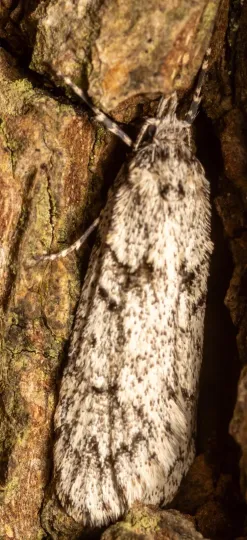
The Northern Winter Moth, scientifically known as Diurnea fagella, is a moth species with a wingspan of approximately 25 millimeters. The species exhibits significant sexual dimorphism, where males possess functional, grey-brown wings, while females have highly reduced wings and are flightless.
Taxonomically, it belongs to the order Lepidoptera and the family Chimabachidae. These moths are nocturnal and are typically observed in the early spring, often attracted to artificial light sources during the night.
The larvae, or caterpillars, are the primary life stage of concern for plant health. Growing up to 20 millimeters, they have a greenish body with a dark head and light dorsal lines, providing excellent camouflage against foliage.
Pupation occurs in the soil or within curled leaves, where the pupa overwinters. This lifecycle strategy allows the species to survive the harsh winter conditions of temperate forests.
The moth's presence is primarily identified by its distinct early emergence compared to most other lepidopteran pests, which typically appear later in the season.
What it damages
The Northern Winter Moth is a polyphagous pest, though it has a strong preference for deciduous trees. Key host plants include beech, oak, lime, birch, and hazel trees.
In managed landscapes or nurseries, the larvae may feed on various fruit and ornamental tree species, potentially causing economic losses if infestations are severe.
The larvae feed on the leaf blades, creating ragged edges and large holes. In cases of high population density, entire trees may suffer significant defoliation during the growing season.
Such damage impairs the tree's photosynthetic ability, leading to reduced growth rates and increased susceptibility to environmental stress, pathogens, and secondary wood-boring insects.
Young trees are particularly vulnerable, as their smaller canopy area means that even moderate larval feeding can lead to significant physiological stress.
##season##The lifecycle of Diurnea fagella is strictly seasonal, with adult emergence occurring as early as March or April. This early timing provides an advantage as larvae hatch in sync with bud burst.
Following mating, females deposit eggs on the bark or near the leaf buds of host plants. Embryonic development is rapid, ensuring that larvae are ready to feed as soon as new leaves unfurl.
Larval activity reaches its peak in late spring and early summer (May and June), coinciding with the period of maximum leaf development in deciduous forests.
By mid-summer, larvae descend to the ground to pupate. The pupal stage remains dormant in the soil litter for the duration of the autumn and winter months.
The species completes one generation per year, making the early spring window the most critical time for monitoring and intervention.
Signs of infestation
Signs of infestation include rolled or spun leaves held together by silk webbing. If a leaf is unrolled, a greenish caterpillar is often found hiding inside.
Visible damage includes skeletal leaf patterns or irregular, large holes along the leaf margins. Extensive feeding often leaves the canopy looking thin or tattered by June.
Early yellowing and premature leaf drop are common in heavily infested trees, as the physiological damage prevents the tree from maintaining its foliage until autumn.
Adult males are often seen fluttering around porch lights or windows in early spring, which serves as a warning sign for the potential larval presence later in the year.
- Webbing found on young shoots and buds.
- Irregular feeding patterns on leaf edges.
- Leaves rolled into protective shelters.
- Larval excrement (frass) visible on lower leaves.
- Visible canopy thinning in early summer.
Control measures
Biological control methods are highly effective, including the preservation of natural predators such as insectivorous birds and parasitic wasps that feed on moth larvae.
In horticultural settings, applications of Bacillus thuringiensis (Bt) are highly recommended, as they specifically target lepidopteran larvae while sparing beneficial insect species.
For severe infestations, horticultural oils or systemic insecticides may be applied during the early larval stage to minimize damage to the foliage.
Good sanitation practices, such as removing leaf litter and mulch from under affected trees, can help reduce the number of successful overwintering pupae.
Regular monitoring using light traps in March and April can help assess population trends and allow for timely interventions before extensive feeding occurs.
Taxonomy
- Latin name
- Diurnea fagella
- Order
- Lepidoptera (butterflies)
- Family
- Chimabachidae
- EPPO code
- CHIBFA
Discussion
No discussions yet — be the first.