
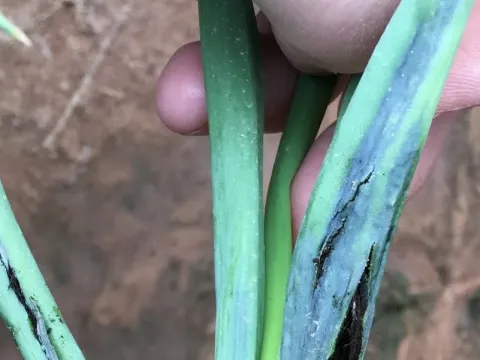
Onion smut
Urocystis magica
The causative agent of the disease is the fungus Urocystis magica, which belongs to the Kingdom Fungi and the Phylum Basidiomycota. It is an obligate parasite that specifically infects plants within the Allium genus.
What the section contains
Onion smut
The pathogen survives in the soil as teliospores, which can remain viable for several years. These spores are highly resistant to adverse environmental conditions, making eradication from the soil extremely difficult.
The mycelium grows within the host plant tissues, gradually disrupting cellular integrity. During the reproductive phase, the fungus produces masses of dark spores that rupture the plant epidermis.
Spore dissemination occurs primarily via wind, irrigation water, and the movement of contaminated bulbs or soil. Infection typically occurs at the seedling stage when tissues are most susceptible to fungal penetration.
The disease thrives in cool, moist soil conditions, with an optimal temperature range for infection being between 10°C and 20°C. Early spring planting often coincides with these favorable conditions.
Onion smut affects various Allium species, including bulb onions, leeks, shallots, and Welsh onions. It is particularly damaging to crops grown from seed (black seeds) during the first year of production.
The primary impact is the stunting and premature death of seedlings. Infected plants often fail to develop healthy bulbs, as the leaves wither and collapse long before harvest time.
Severe infestations can lead to yield losses ranging from 50% to 80% in affected fields. Furthermore, weakened plants are highly susceptible to secondary bacterial soft rot infections.
If the fungus reaches the bulb, it causes the basal plate to crack, leading to rotting during storage. This makes the harvested crop commercially non-viable and risks spreading the pathogen further.
The presence of onion smut significantly restricts the use of infested land for future Allium production, necessitating long-term crop rotation plans and rigorous sanitation practices.
The earliest symptoms appear as elongated, pale, or whitish streaks on the cotyledons and the first true leaves. As the disease progresses, these streaks become dark due to spore formation.
A hallmark sign is the rupture of the leaf surface, revealing a dusty, charcoal-black mass of spores. Leaves usually twist, spiral, or bend significantly and eventually dry out prematurely.
In mature plants, lesions may manifest on the succulent scales of the bulb. The internal tissues appear discolored and friable, often accompanied by the premature splitting of the bulb neck.
The root system of infected plants is poorly developed and may show signs of decay, causing the plant to be easily dislodged from the soil. This lack of root vigor leads to overall wilting.
Visually, affected areas in a field appear as patches of stunted, yellowed, and malformed plants standing out against the healthy growth of the surrounding crop.
Crop rotation is the most critical control measure, with a recommended interval of at least 5 to 7 years between Allium crops to allow soil spore populations to decline naturally.
Using certified, disease-free seed is essential. Treating seeds with systemic fungicides before planting can protect seedlings during the critical early stages of development.
Transplanting healthy sets or transplants rather than direct-seeding can reduce infection rates, as older tissues have greater resistance to penetration by the fungus.
Managing soil moisture and providing balanced nutrition helps maintain plant vigor. Avoid over-application of nitrogen, which can lead to rapid, succulent growth that is more easily penetrated by the pathogen.
- Remove and destroy all infected plant material after harvest.
- Ensure strict sanitation of equipment and tools used in affected fields.
- Incorporate soil solarization or fumigation where economically feasible.
- Select resistant cultivars whenever they are available for local conditions.