
Trichaptum abietinum
Trichaptum abietinum
Trichaptum abietinum is a fungus in the family Polyporaceae. It is well-known as a wood-decay pathogen that plays a significant role in the decomposition of coniferous trees.
What the section contains
Trichaptum abietinum
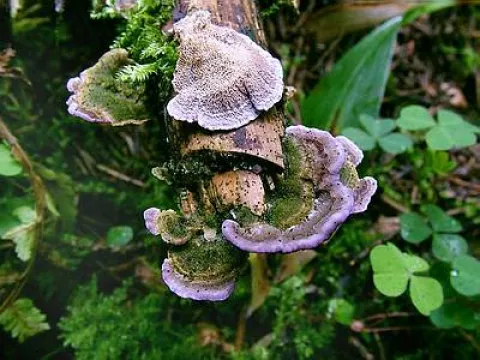
The fruit bodies are annual, ranging from small to medium-sized, and typically grow in imbricate, shelf-like clusters on the bark of dead or weakened trees.
The upper surface of the cap is covered with dense, grayish-violet hairs that eventually fade to gray or brownish as the fungus matures.
The hymenium is tubular, and the pores are often maze-like (daedaloid), which serves as a key diagnostic feature for mycologists and forest pathologists.
It reproduces via basidiospores that are released into the air, allowing the fungus to colonize new substrates whenever conditions are appropriate.
The primary hosts of this pathogen are coniferous species, including spruce, fir, pine, and larch. It acts as a facultative parasite, attacking stressed trees and saprotrophically decaying fallen logs.
The fungus causes a white pitted rot. As the mycelium grows, it breaks down cellulose and lignin, leading to the loss of structural integrity in both sapwood and heartwood.
In living trees, the rot typically enters through mechanical injuries, frost cracks, or sites damaged by bark-boring insects, eventually compromising the tree's vascular system.
Economically, it causes major losses in stored timber. If logs are stored in humid conditions without proper aeration, the fungus can rapidly render the wood useless for commercial purposes.
Trees affected by the fungus show decreased growth vigor and are more susceptible to windthrow due to the internal weakening of the wood structure.
Growth is highly dependent on environmental factors, particularly temperature and moisture content within the woody substrate.
Mycelial activity peaks during the growing season, especially during periods of high humidity and rainfall, which facilitate the development of the fruit bodies.
Spore production can occur throughout the vegetative period, peaking in late summer and autumn when conditions are optimal for the fungus's lifecycle.
The fungus is capable of surviving harsh winter conditions as dormant mycelium within the wood, waiting for favorable temperatures to resume growth in spring.
Consistent moisture levels are the most critical factor; in dry environments, the rate of wood decay slows significantly, and fruit body production ceases.
The most visible sign is the presence of violet-tinged, shelf-like fruit bodies on the bark or wood surfaces, which are distinctively fuzzy to the touch.
Internal examination of infested wood reveals the presence of white, pocketed decay and sometimes thin, white mycelial mats or cords under the bark layers.
Affected trees may exhibit thinning crowns and yellowing needles as the decay process interrupts the transport of water and nutrients from the roots.
Bark in infected areas may become loose or cracked, revealing the white, spongy decay beneath, which is a classic indicator of wood-destroying fungal activity.
On stumps, the fungus often appears as extensive colonies of fruit bodies, which can cover large surface areas, indicating advanced stages of colonization.
Sanitation is the most effective control method. Removing infected trees, logging slash, and deadwood prevents the buildup of inoculum in the forest.
For timber stored at depots, logs should be kept off the ground using racks and stored in well-ventilated areas to ensure rapid drying of the wood.
Protecting living trees from logging damage and insect infestations is essential, as these injuries are the primary entry points for fungal spores.
In specialized settings, such as forest nurseries or timber preservation, chemical fungicides can be applied to cuts or logs to inhibit fungal establishment.
Effective forest management that promotes tree health and avoids overcrowding helps the stand remain resilient against primary infections by wood-rotting pathogens.