
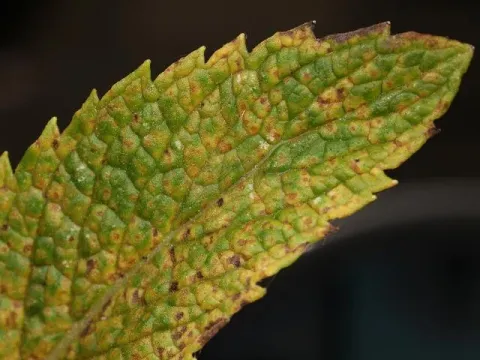
Septoria leaf spot of mint
Septoriamenthae
Septoria leaf spot of mint is a significant fungal disease caused by the pathogen Septoria menthae. This fungus belongs to the family Mycosphaerellaceae and is known to be a host-specific parasite of mint species.
What the section contains
Septoria leaf spot of mint
The fungus survives the winter primarily in infected crop residues and soil, where it forms pycnidia. These fruiting bodies contain spores that act as the primary inoculum for new infections in the spring.
Laboratory diagnosis involves the examination of leaf samples to identify the characteristic pycnidia. These are small, dark, flask-shaped structures that release conidia when exposed to moisture.
Environmental conditions play a crucial role in disease development. High humidity and moderate temperatures favor the dispersal and germination of fungal spores, leading to rapid spread within the mint field.
Accurate identification is essential for implementing effective control measures. Pathologists recommend regular scouting during the growing season to detect early symptoms of Septoria menthae.
The disease primarily attacks the leaves, though severe infections can spread to stems and petioles. Peppermint and other commercial mint varieties are highly susceptible to this pathogen.
Economic damage manifests as a reduction in both biomass and oil quality. Infected leaves become photosynthetically inactive, leading to stunted growth and reduced yield of essential oils.
Severe defoliation weakens the mint plants, making them more susceptible to cold stress during winter. This can lead to thin stands and reduced productivity in subsequent growing seasons.
Contaminated raw material often fails to meet quality standards for essential oil extraction or pharmaceutical use. This can lead to significant financial losses for commercial mint growers.
The impact of the disease is exacerbated when mint fields are not properly managed. Continuous cropping and dense plant spacing contribute to the build-up of the pathogen over several years.
The primary symptom is the appearance of small, circular spots on the leaves. These spots usually have a brown or greyish center surrounded by a darker, often reddish-brown margin.
As the disease progresses, tiny black dots—the pycnidia—become visible in the center of the spots. These structures are a key diagnostic feature for confirming a Septoria infection.
Infected leaves eventually turn yellow (chlorosis), shrivel, and fall prematurely. This leads to the characteristic thinning of the lower canopy of the mint plants.
Under warm and moist conditions, the spots may enlarge and coalesce, resulting in large areas of necrotic tissue. This destruction of leaf tissue severely impacts the plant's metabolism.
While less common, lesions on the stems can weaken the structural integrity of the plant, causing stalks to wilt or snap, especially during high winds or rain.
Cultural management is the first line of defense. Growers should implement strict crop rotation cycles, avoiding the planting of mint in infested fields for at least three to four years.
Sanitation is vital: all infected plant debris must be removed or buried deeply through plowing immediately after harvest to reduce the primary inoculum load in the field.
Chemical control involving fungicides can be effective if applied early in the disease cycle. It is important to use products specifically approved for use on mint to avoid chemical residue issues.
- Maintaining proper plant spacing to ensure adequate air circulation.
- Using only certified disease-free propagation material.
- Managing irrigation systems to avoid long periods of leaf wetness.
Integrated Pest Management (IPM) strategies, including monitoring and timely intervention, are the most sustainable ways to keep Septoria menthae under control and protect yield potential.