
Septoria leaf spot of sunflower
Septoria helianthicola
Description
How to identify
The causative agent of the disease is the imperfect fungus Septoria helianthicola, belonging to the Ascomycota division. This pathogen is a specialized fungus that infects sunflower tissues during the active growing season.
Mycologically, the object is a pycnidial fungus that forms small black fruiting bodies, known as pycnidia, within the infected tissues. These pycnidia produce thread-like or slightly curved spores (pycnospores), which serve as the primary source of infection spread in the field.
The fungus is systematically adapted to a parasitic lifestyle on members of the Asteraceae family. Its life cycle is closely linked to crop residues, where the fungus survives as mycelium or pycnidia during the winter period.
Externally, the presence of the pathogen is easily identified during wet weather when spore masses emerge from the pycnidia as slimy droplets or threads. This is a primary sign allowing differentiation of Septoria from other leaf spots.
The dissemination of conidia occurs primarily through rain splashes, irrigation water, and wind currents, which carry the spores to the healthy leaves of neighboring sunflower plants.
What it damages
Septoria leaf spot primarily affects the vegetative organs of the sunflower, specifically the leaves of the lower, middle, and upper tiers. Under conditions of an epidemic, the infection can cover almost the entire leaf surface of the crop.
The main damage consists of premature wilting and necrosis of infected leaves, which critically disrupts the plant's photosynthesis process. Without a healthy leaf area, the sunflower cannot form a high-quality flower head.
Reduced productivity manifests as a decrease in the diameter of the head and the weight of 1000 seeds. In severe cases, crop losses can range from 10% to 25%, depending on the hybrid variety and weather conditions.
Beyond direct yield loss, the disease negatively impacts crop quality. The oil content of the seeds drops significantly as the plant diverts resources toward attempts to regenerate damaged tissues.
Infection by Septoria also reduces the general resilience of the sunflower against environmental stressors, including drought and secondary infections that penetrate through damaged leaf blades.
When it appears
The first signs of the disease usually appear during the phase of 2–4 pairs of true leaves. The infection progresses throughout the growing season, reaching its peak activity before the flowering stage.
Favorable conditions for the fungus's intensive development include moderately warm weather (temperatures between +20°C and +25°C) and high air humidity (over 80%). Frequent rains and heavy dew facilitate rapid spore dissemination.
The development of the disease is cyclical: the incubation period lasts from 5 to 10 days, depending on hydrothermal conditions. During the summer, the fungus can produce several generations of conidia, leading to a rapid buildup of the epidemic.
In dry weather, the pathogen's activity noticeably decreases, though it survives within the tissues in a latent form, waiting for favorable conditions to resume spore production.
In the autumn, during harvest, the infectious background increases significantly due to the accumulation of pycnidia on all crop residues left in the field, providing the fungus with reliable overwintering.
Signs of infestation
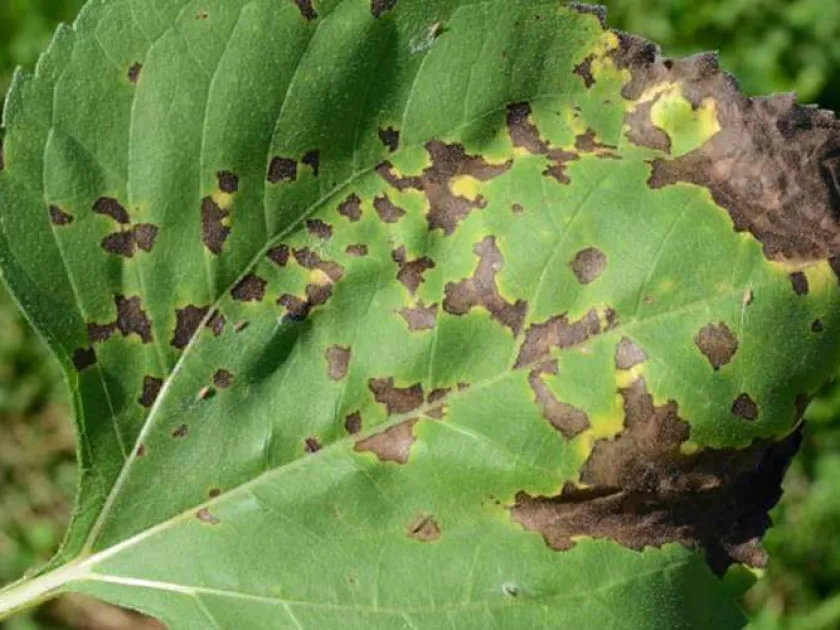
A typical sign of infection is the presence of localized spots on the leaves, which initially have a light-gray or yellowish hue. As the fungus develops, the spots turn dark brown, often with a yellow halo.
In the center of older spots, small black structures — pycnidia — gradually form and are clearly visible to the naked eye. This is the main diagnostic feature of Septoria leaf spot.
- Appearance of angular or circular spots on the lower leaves.
- Gradual merging of spots into large necrotic zones.
- Yellowing and browning of leaves, starting from the base of the stem.
- Premature dropping of infected leaf blades.
- Presence of black dots (pycnidia) on the necrotic leaf tissue.
It is important not to confuse Septoria with Alternaria or Phoma leaf spot. In the case of Septoria, the spots have more distinct boundaries, and the presence of numerous black pycnidia in the center of the necrosis is a definitive indication of Septoria helianthicola.
Control measures
Agronomic management practices are the foundation of crop protection. Maintaining crop rotation, with sunflower returning to the same field no sooner than every 6–8 years, is of the utmost importance.
Thorough incorporation of crop residues into the soil via deep plowing promotes the rapid decomposition of the pathogen's mycelium. Eliminating volunteer sunflowers removes the fungus's survival reservoirs.
The application of chemical fungicides remains the most effective protection method during the growing season. Treatments should be carried out preventively or upon the first signs of the disease at the 6–8 leaf pair stage.
Systemic fungicides from the triazole or strobilurin groups, or their combinations, are used. They effectively suppress spore production and fungal mycelium growth within the plant tissues.
Using sunflower hybrids that are resistant or tolerant to Septoria allows for a significant reduction in infection intensity and minimizes economic risks even under weather conditions favorable to the fungus.
Causes diseases · 1
Discussion
No discussions yet — be the first.