
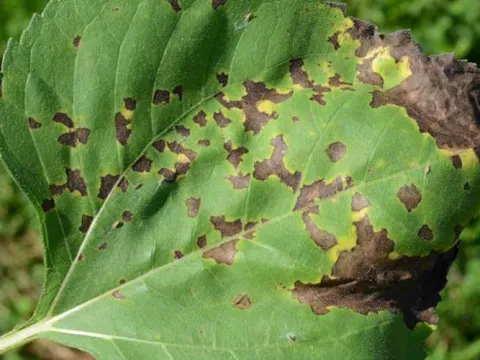
Septoria leaf spot of sunflower
Septoria helianthina
The causative agent of the disease is the fungus Septoria helianthina, which belongs to the division Ascomycota. This pathogen is a specialized parasite that exclusively affects sunflower crops.
What the section contains
Septoria leaf spot of sunflower
The fungus persists in the soil and on crop residues in the form of pycnidia. The infection spreads via conidia, which are dispersed by rain splashes or wind onto healthy plant tissues.
High air humidity and moderate temperatures are required for fungal development, making it particularly dangerous in regions with frequent rainfall during the growing season.
The pathogen's life cycle involves primary infection of the lower leaves followed by the upward spread of the disease through the stem to the upper parts of the plant.
The development of the disease is marked by the formation of pycnidia on the lesions, which appear as small dark spots visible upon detailed inspection of the affected areas.
Septoria leaf spot primarily affects the vegetative organs of the plant: leaves, petioles, and stems. In rare cases, it can affect the sunflower head, significantly reducing seed weight.
The disease leads to premature death of the foliage. Due to impaired photosynthesis, the plant cannot accumulate sufficient nutrients for proper seed development.
Severe infection causes premature drying of the lower and middle parts of the stem, weakening the plant's structural integrity and leading to lodging of the crops.
The damage manifests as a significant reduction in grain yield and a decrease in oil content, which negatively impacts the market quality of the harvest.
Stalk lesions can cause brittleness, creating serious difficulties during mechanized harvesting and increasing crop losses in the field.
Initial signs of the disease usually appear on seedlings or during the development of the first true leaves if the infectious background in the soil is high.
The peak of disease progression occurs in the second half of the growing season, when conditions of high humidity and temperatures around 20–25 degrees Celsius prevail.
Heavy dew and frequent rains in late summer facilitate the rapid spread of spores and allow the pathogen to cover the entire area of the leaf blades.
The disease progresses actively in dense plantings, where a favorable microclimate with slow evaporation of moisture from the leaf surfaces is created.
During dry periods, the development of Septoria leaf spot may slow down, but the fungus remains viable, waiting for favorable conditions to resume its life cycle.
Initial symptoms are characterized by small greyish-brown spots that gradually increase in size and take on an angular shape.
The spots are usually delimited by leaf veins, giving them a polygonal appearance. Over time, the center of the spot lightens, while the edges remain dark brown.
A characteristic diagnostic sign is the appearance of small black dots — the fungus's pycnidia — in the center of the necrotic spots, clearly visible on both sides of the leaf.
As the pathogen develops, the spots merge, and the affected tissues turn yellow, dry out, and fall away, resulting in holes forming on the leaf blades.
- Yellowing of lower leaves
- Brown angular spots
- Black dots (pycnidia) on necroses
- Premature leaf drying
Agronomic practices include strict adherence to crop rotation, with sunflowers not returning to the same field for at least 6–8 years, as well as deep plowing of crop residues.
The use of resistant hybrids is the most effective and economically viable method for controlling the spread of Septoria on large areas.
Chemical control involves the application of systemic fungicides, such as triazoles or strobilurins, during the active growth phase of the sunflower (3–6 leaf pairs).
Managing weeds, which can act as reservoirs for the infection, and controlling plant density help reduce humidity in the root zone.
Field monitoring during critical growth stages allows for timely protective measures to be taken and prevents the development of epiphytotic disease outbreaks.