
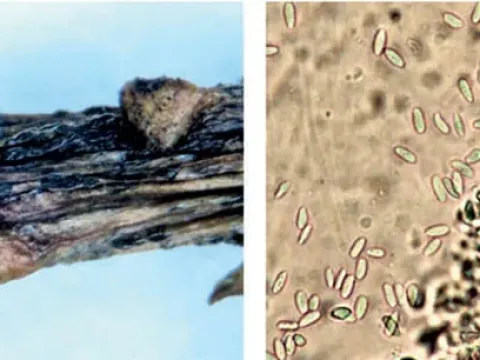
Sclerophoma pythiophila
Sclerophoma pythiophila
Sclerophoma pythiophila is a fungal pathogen classified within the Dothideomycetes class. It is recognized as a specific agent causing needle blight and shoot dieback in various pine species, primarily affecting young trees and nursery stock.
What the section contains
Sclerophoma pythiophila
The fungus produces small, black, spherical fruiting bodies known as pycnidia. These structures typically erupt through the epidermis of the needles or the bark of young shoots to release spores.
The conidia (asexual spores) are hyaline, single-celled, and elliptical. They are primarily dispersed by rain splash and wind, which facilitates the rapid spread of the disease within dense forest stands or nursery beds.
This fungus acts as both a parasite on living plant tissues and a saprophyte on fallen needles and decaying twigs, allowing it to persist in the environment even when a susceptible host is not immediately available.
While pine (Pinus spp.) is the primary host, the pathogen thrives in environments where humidity remains high, which is typical for young plantations and sheltered nursery settings.
The pathogen causes the most severe damage to seedlings and young trees under 15 years of age. It attacks needles, buds, and succulent shoots, leading to tissue necrosis and terminal bud death.
Extensive infestation results in premature needle drop, which significantly reduces the tree's photosynthetic capacity and weakens its overall vigor. In severe cases, it can cause the entire crown to wither.
By weakening the host tree, Sclerophoma pythiophila predisposes the pines to secondary infestations by bark beetles and other wood-boring insects, compounding the damage to the forestry crop.
Economic losses in nurseries are substantial, as the blight can render large batches of seedlings unsuitable for outplanting, necessitating the destruction of infected inventory.
Chronic infections lead to stunted growth and malformation of the tree's architecture, as repeated loss of leaders and lateral shoots prevents the tree from developing a healthy, symmetrical form.
Infection occurs throughout the growing season, but the highest disease pressure is observed during spring and early summer when rainfall is frequent and temperatures are moderate.
The fungus thrives in high humidity. During rainy periods, the pycnidia become active, ejecting large masses of conidia that are easily transported by moisture to neighboring healthy needles.
As autumn approaches, the pathogen transitions into an overwintering state. It survives the cold season as mycelium and dormant fruiting bodies within infected plant material, including fallen litter and bark tissues.
The resilience of the pathogen to freezing temperatures ensures that the inoculum remains viable on the forest floor throughout the winter, ready to re-infect the lower branches once spring conditions return.
Effective disease management requires awareness of these seasonal cycles, as protective measures are most critical during the active sporulation phases of the early growing season.
The initial symptom is the chlorosis (yellowing) of the needles, which quickly progresses to a reddish-brown or grayish-brown discoloration. Eventually, the affected needles turn brittle and dry.
A definitive diagnostic feature is the presence of minute black pycnidia on the surface of the needles. These can be seen as small dots arranged in irregular lines or clusters, especially visible with a hand lens.
Shoots may become distorted, and small cracks in the bark can develop as the fungal mycelium penetrates the cortex. In advanced stages, the branches become barren due to premature needle shedding.
- Discoloration and browning of needles starting from the base.
- Premature needle cast.
- Visible black pycnidia on infected needles or twigs.
- Dieback of terminal and lateral shoots.
The infection typically follows a bottom-up progression in the crown, as lower branches often experience lower airflow and higher humidity, creating an ideal microclimate for the pathogen.
Sanitation is the most effective management strategy. This includes the regular removal and destruction (preferably by burning) of all infected branches and needle litter to reduce the inoculum pool.
In nursery management, maintaining proper spacing between seedlings is essential to promote air circulation and reduce the duration of surface wetness on the needles, which inhibits fungal spore germination.
Chemical control involving copper-based fungicides (such as Bordeaux mixture) can be applied preventatively during the spring and early summer to protect young foliage from new infections.
Regular surveillance of forest stands is necessary to identify disease outbreaks early, allowing for targeted sanitation efforts before the infection can spread to the rest of the plantation.
Promoting general tree health through proper site selection, adequate fertilization, and stress management helps trees develop higher natural resistance to the pathogen, significantly lowering the risk of infestation.