
Sclerospora macrospora
Sclerospora macrospora
Description
How to identify
Sclerospora macrospora is an obligate parasite classified within the kingdom Chromista and the phylum Oomycota. It is a fungus-like organism that causes systemic infections in various cereal species.
The mycelium of the pathogen colonizes the entire host plant, migrating through the vascular tissues. It eventually forms thick-walled oospores, which are specialized survival structures.
Unlike true fungi, this organism belongs to the group of oomycetes, meaning it requires water-saturated environments for the release and motility of its zoospores.
It maintains its life cycle by persisting in the soil as oospores, which can remain dormant and infectious for several years under appropriate environmental conditions.
Identification is typically achieved by examining infected plant tissues for hypertrophy, characteristic malformations of the inflorescence, and microscopic identification of oospores.
What it damages
The pathogen infects a wide range of graminaceous crops, including wheat, barley, rye, oats, and various wild grass species, causing systemic disruption.
The disease, globally known as crazy top, causes severe morphological aberrations in the reproductive parts of the host plants, rendering them effectively sterile.
The economic impact is significant, particularly in fields with poor drainage or those prone to flooding, leading to total yield loss in affected plant clusters.
Because the infection is systemic, it alters the plant's hormonal balance and developmental pathways from a very early stage of growth.
The damage is not just limited to yield reduction but also includes the impairment of plant vigor, resulting in stunted, bushy, and non-productive crops.
When it appears
The primary infection period occurs during the early seedling stage, triggered by high soil moisture levels that facilitate the germination of overwintering oospores.
Zoospores are released into the soil water and migrate toward the roots of young cereal plants, initiating the systemic invasion of the host tissues.
Epidemics are most frequently associated with heavy rainfall and stagnant water on fields, which provide the necessary aquatic environment for the pathogen's motility.
As the plant progresses toward maturity, the pathogen completes its cycle, focusing on the production of resting oospores within the dying plant tissue.
After the harvest, these oospores are incorporated back into the soil, where they survive until the next cycle of favorable environmental conditions occurs.
Signs of infestation
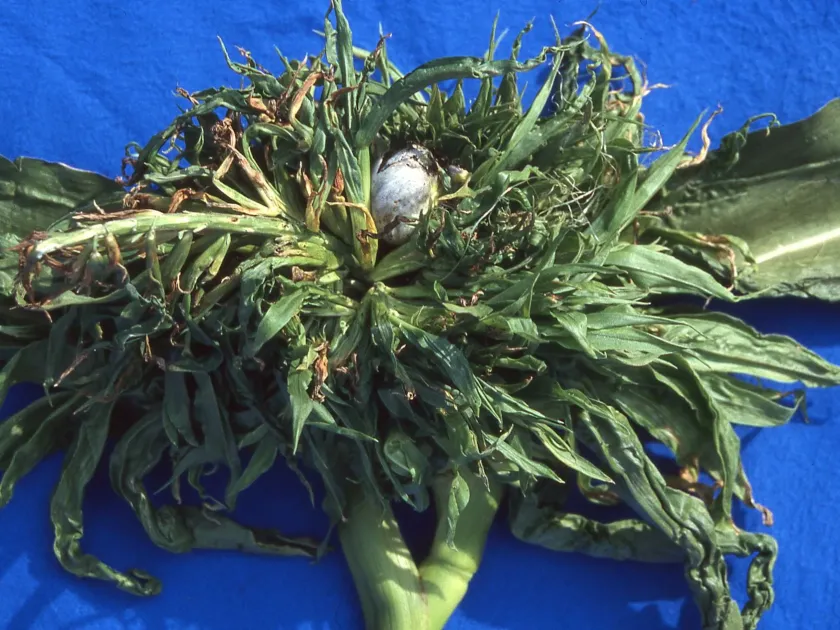
The most distinctive symptom is the crazy top effect, where the inflorescence undergoes hypertrophy, becoming a distorted, leafy, and disorganized bundle of tissues.
Plants often exhibit severe stunting, thickened and stiffened leaves, and a bushy appearance due to abnormal and excessive tillering at the base.
The internodes of the stems become significantly shortened, giving the plant a compacted, rosette-like morphology compared to healthy, elongated wheat or barley stems.
Chlorotic striping on the leaves is a common early symptom, often progressing to necrosis as the disease advances and the plant struggles to metabolize normally.
- Inflorescence malformation.
- Extreme plant stunting.
- Excessive, non-productive tillering.
- Leaf thickening and striping.
- Total loss of grain production.
Control measures
The primary control strategy involves improving field drainage to prevent water stagnation, which is critical for the pathogen's ability to infect new hosts.
Crop rotation is essential; fields known to be infested should be kept free of susceptible graminaceous hosts for at least three to four years to reduce inoculum density.
Effective weed management is necessary, as various wild grasses can serve as alternative hosts and reservoirs for the pathogen during off-seasons.
Implementing deep plowing helps bury infected crop debris, accelerating decomposition and reducing the survival rates of oospores in the topsoil layers.
Selecting varieties that are tolerant to waterlogging can significantly mitigate the impact of the disease, as they are less likely to support the severe systemic symptoms triggered by flooding.
Causes diseases · 2
Discussion
No discussions yet — be the first.