
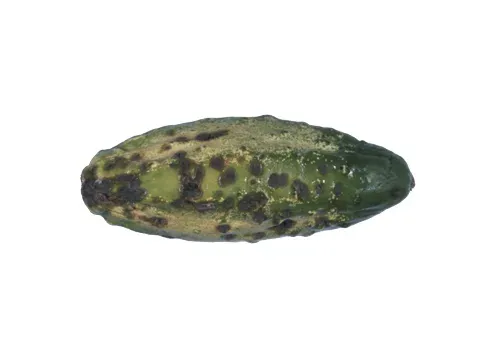
Scab of cucumber
Cladosporium cucumerinum
The causative agent of the disease is the imperfect fungus Cladosporium cucumerinum from the order Hyphomycetales. This phytopathogen primarily affects plants of the Cucurbitaceae family, causing a disease known as olive leaf spot or cucumber scab.
What the section contains
Scab of cucumber
The fungal mycelium develops in the intercellular spaces of plant tissues, forming conidiophores that emerge through stomata or epidermal ruptures. The fungus has a high adaptation capacity, surviving in soil, on crop residues, and on greenhouse structures as conidia and mycelium.
Systematically, the pathogen belongs to the kingdom Fungi, phylum Ascomycota, class Dothideomycetes. It is an obligate parasite whose survival depends directly on accessing nutrients from a living host plant.
The fungal spores (conidia) are oval or cylindrical, often two-celled, and olive-colored. They are easily dispersed by air currents, water droplets during irrigation, or via contaminated agricultural tools.
The disease development is typically epiphytotic when temperature and humidity regimes are violated, making accurate identification of the pathogen critical for effective field management.
The disease affects all aerial parts of the plant: leaves, stems, and most importantly, the fruits. Damage from scab can reach up to 80% of the yield during severe outbreaks.
The greatest economic loss is due to the deterioration of fruit quality. Deep lesions appear on young ovaries, causing the fruits to twist, become deformed, and unsuitable for market or processing.
Leaf damage leads to a reduction in photosynthetic surface area, which slows plant growth and depletes nutrient reserves. Premature leaf death halts the development of new fruits.
Cracks and lesions may appear on the stems, which become covered with an olive-colored fungal mat in humid conditions. This weakens the plant's overall immunity, facilitating secondary colonization by other opportunistic pathogens.
In commercial production, cucumber scab is considered one of the most dangerous greenhouse diseases, capable of destroying a significant portion of marketable production in a short time.
The first symptoms often appear during the peak fruiting phase. In greenhouses, the disease can occur year-round if microclimate requirements are not met.
Optimal conditions for infection are air temperatures between 16–22°C and high relative humidity (above 90%). Sharp temperature fluctuations, which lead to condensation, trigger active conidia germination.
The fungus's life cycle under favorable conditions takes only a few days. Conidia germinate in the presence of free water, penetrating plant tissues within hours.
Pathogen spread is exacerbated by overhead irrigation, which splashes water from infected areas to healthy tissues, spreading spores throughout the greenhouse.
By the end of the season, the concentration of inoculum in the soil and on greenhouse structures reaches a maximum, requiring thorough disinfection before the next cropping cycle.
Leaves develop numerous small angular spots that gradually lighten and turn greyish-brown. The tissue in the center of the spots often falls out, creating holes.
On the undersides of leaves and on infected fruits, a velvety olive-colored mat is visible. This is a cluster of conidiophores and conidia, which is a key diagnostic feature of the disease.
Small, water-soaked spots form on fruits, rapidly turning into deep, dry or slightly moist lesions. Over time, these lesions crack, leading to fruit deformation.
Infected ovaries often turn yellow, wither, and stop growing. In high-humidity conditions, lesions can expand, merging to cover a significant portion of the fruit surface.
- Yellowing of tissues surrounding leaf spots.
- Deformation of fruits (hooking).
- Velvety olive-colored growth on infected parts.
- Rapid expansion of necrosis in high humidity.
The primary control measure is maintaining an optimal microclimate: preventing sharp temperature fluctuations and strictly keeping air humidity below 80%.
Avoid overhead irrigation (sprinkling), favoring drip irrigation instead. Regular greenhouse ventilation helps reduce humidity and hinders spore germination.
Agronomic methods include mandatory removal and destruction of all crop residues, the use of resistant hybrids, and crop rotation, which excludes planting cucumbers on the same site for at least 3-4 years.
Chemical control involves fungicides from the strobilurin, triazole, and copper-based groups. Treatments are applied preventively or upon the first signs of symptoms, adhering to pre-harvest intervals.
Biological methods include using products based on Bacillus subtilis and other antagonists of fungal diseases, which effectively suppress infection development during initial stages.