
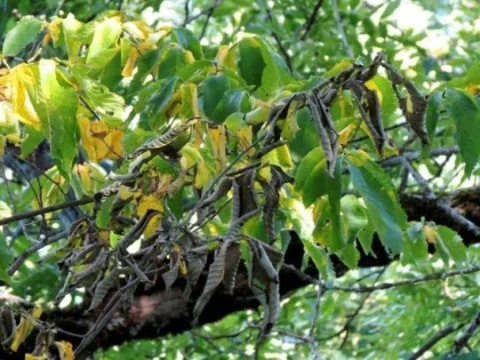
Ophiostoma ulmi
Ophiostoma ulmi
Ophiostoma ulmi is an ascomycete fungus and the primary pathogen responsible for Dutch Elm Disease, a devastating vascular wilt that affects elm trees globally.
What the section contains
Ophiostoma ulmi
The fungus is primarily transmitted by elm bark beetles (genus Scolytus), which act as vectors, carrying fungal spores from infected trees to healthy ones during feeding.
The biological cycle of the fungus involves both sexual and asexual stages. Within the host tree, it develops as a mycelium and produces spores that colonize the xylem vessels.
Taxonomically, it belongs to the order Ophiostomatales. It is known for its high evolutionary pressure, leading to more aggressive strains that have caused widespread mortality in elm populations.
Ophiostoma ulmi persists in dead wood and beetle galleries, ensuring its survival and transmission to new hosts even after the death of the initially infected tree.
The fungus infects members of the Ulmus genus. It causes vascular wilt by obstructing the tree's xylem, effectively cutting off the supply of water and nutrients.
The damage is systemic: the tree reacts by producing gums and tyloses to wall off the infection, which ironically accelerates the blockage of its own water transport system.
Infected trees suffer from rapid defoliation, branch dieback, and eventually total mortality. This disease has fundamentally altered the composition of forests and urban landscapes across many regions.
Large, mature trees are particularly susceptible to the infection, as their complex vascular network allows for the rapid spread of the fungus throughout the entire crown.
Beyond individual tree loss, the disease causes significant economic loss and ecological degradation by destroying the canopy cover and local biodiversity associated with elm species.
The earliest symptom is the flagging of leaves on one or more branches, typically occurring in early to mid-summer, where leaves turn yellow, wilt, and curl.
A diagnostic sign is the appearance of brown or black streaking in the sapwood, which can be observed by peeling back the bark or examining a cross-section of a twig.
The presence of beetle galleries beneath the bark confirms the role of bark beetles as vectors, providing clear evidence of the transmission mechanism.
Over time, the tree exhibits progressive dieback of the crown, leading to a thin, sparse appearance before the tree dies completely.
In cases of root-to-root transmission, death can occur in circular patterns in a forest stand, creating expanding pockets of dead elm trees over several seasons.
Management strategies focus on reducing the inoculum density by removing and properly disposing of infected elm wood before beetles can emerge.
The use of insecticides to control bark beetle populations is often limited by environmental concerns, but remains a tool in specific high-value urban forest management programs.
Systemic fungicides, specifically injected into the trunk, are used as a preventive measure to protect high-value specimen trees in botanical gardens and public parks.
Long-term success depends on planting resistant or tolerant elm cultivars and maintaining the overall health of existing trees to increase their resilience.
- Strict sanitary removal of infected trees and branches.
- Root trenching to prevent underground spread via root grafts.
- Monitoring beetle populations using pheromone-based traps.
- Planting non-susceptible elm species for future reforestation.