
Mycosphaerella cruenta
Mycosphaerella cruenta
Mycosphaerella cruenta is an ascomycete fungus that serves as the teleomorph of the pathogen commonly causing leaf spot diseases in legumes. Its anamorph, Pseudocercospora cruenta, is responsible for the rapid spread of conidia during the growing season.
What the section contains
Mycosphaerella cruenta
The fungus is classified within the kingdom Fungi and phylum Ascomycota. It exhibits a high degree of host specificity, primarily targeting species within the Fabaceae family. Its survival strategy involves overwintering on infested plant debris, making it a persistent threat in agricultural environments.
The primary host for this pathogen is the common bean (Phaseolus vulgaris). Other legumes, such as cowpea (Vigna unguiculata), are also susceptible, leading to significant yield losses in warm climate regions worldwide.
The infection severely damages the photosynthetic machinery of the plant. Infected leaves wither and drop prematurely, which prevents the plant from accumulating enough energy for seed development. This results in reduced grain filling, smaller seed size, and a significant decrease in total harvest quality.
Epidemics of Mycosphaerella cruenta are closely tied to environmental moisture levels. High humidity and rainfall facilitate the dispersal of spores from the soil surface onto the lower leaves of the bean plants.
Development is favored by warm temperatures ranging from 20°C to 30°C. Once established, the fungus can complete its cycle rapidly, producing secondary infections throughout the season whenever rain splashes spores onto healthy foliage.
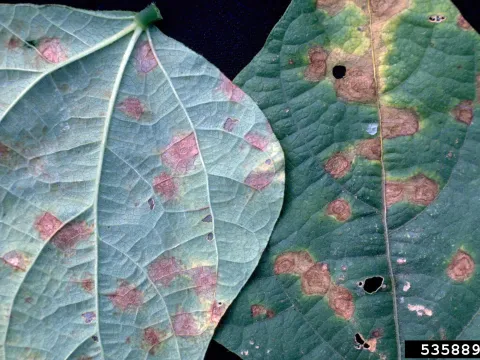
Initial symptoms manifest as small, irregular chlorotic spots on the leaf surface. As the infection progresses, these lesions develop a reddish-brown or purple color, often surrounded by a chlorotic halo.
- Small, necrotic reddish-brown spots on leaves.
- Dark, grayish-olive fungal growth on the underside of the lesions.
- Premature senescence and leaf abscission.
- Defoliation of the lower canopy.
- In severe cases, dark, sunken lesions on the pods and seeds.
Integrated pest management (IPM) is essential for controlling this disease. The use of certified, disease-free seed is the first line of defense to prevent the introduction of the pathogen into new areas.
Cultural practices are critical; growers should remove or deep-plow crop residues to accelerate decomposition and reduce the primary inoculum load. Rotating legumes with non-host crops for at least three years is highly recommended to starve the fungus.
If environmental conditions favor disease spread, preventive application of fungicides is necessary. Products containing copper, triazoles, or strobilurins are effective if applied during the early onset of symptoms to suppress further colonization of the plant tissue.