
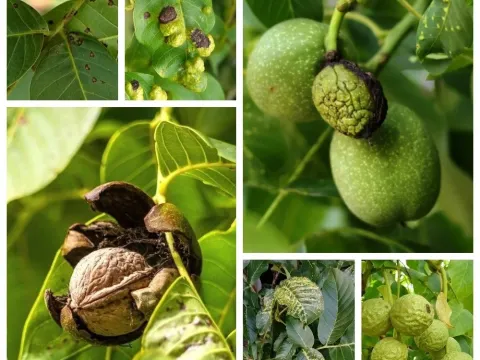
Mycosphaerella leaf spot
Mycosphaerella juglandis
Mycosphaerella juglandis is an ascomycete fungus that serves as the causal agent of brown leaf spot in walnut trees. It belongs to the Mycosphaerellaceae family and is recognized as a significant threat to nut production worldwide.
What the section contains
Mycosphaerella leaf spot
The fungus overwinters primarily as mycelium or as fruiting bodies known as perithecia and pycnidia within fallen leaves. This debris acts as the main reservoir for the pathogen during the cold season, allowing it to survive until spring.
With the arrival of favorable warm and humid weather, the fungus produces ascospores that are discharged into the air. These spores are then dispersed by wind and rain splashes to new, developing foliage.
Infection occurs when spores land on leaf surfaces and find sufficient moisture to germinate. The fungus then colonizes the leaf tissue by penetrating through stomata or directly through the plant cuticle.
Taxonomically classified within the order Capnodiales, this pathogen is well-adapted to the climatic conditions of temperate regions where walnuts are cultivated, making it a persistent issue in many orchards.
The primary host for this disease is the English walnut (Juglans regia). The most visible damage is concentrated on the leaves, where the pathogen destroys cells and disrupts photosynthetic activity.
Heavy infections lead to premature defoliation, which severely compromises the tree's ability to store carbohydrates before winter. This leads to weakened tree vigor and reduced cold hardiness.
Young twigs can also be colonized, resulting in necrotic lesions that can girdle the stem, causing tip dieback and structural damage to the branch architecture.
The economic impact involves both the loss of yield and the reduction in fruit quality. Infected fruits may exhibit spots on their husks, which can lead to early harvest issues or staining of the nut shells.
Long-term damage leads to tree decline, characterized by sparse foliage, stunted shoot growth, and an increased susceptibility to other biotic and abiotic stress factors in the environment.
Symptoms typically appear in the early summer as small, circular, brown spots on the upper leaf surface. Over time, these spots expand and develop a darker brown or black border.
A hallmark diagnostic sign is the appearance of tiny black dots, known as pycnidia, centered within the necrotic spots. These structures are where the fungus produces its asexual spores during the growing season.
As the disease progresses, individual spots may coalesce, creating large irregular necrotic patches. In severe cases, the entire leaf surface may become necrotic, leading to rapid curling and premature leaf fall.
Twigs and shoots may show elongated, sunken dark spots. If the bark is severely affected, the shoots may crack or show signs of localized dieback, which is a clear indicator of systemic infection.
The underside of the leaves in the affected areas may show a subtle grayish or olive-colored fungal growth, which is highly visible under high humidity and serves as a secondary source of inoculant.
Effective management begins with sanitation practices in the autumn. Collecting and removing all fallen leaves is critical to reducing the primary inoculum level for the following growing season.
In commercial orchards, chemical control is often necessary. Preventive fungicide applications, particularly those containing copper, should be initiated before the first signs of infection in early spring.
During the growing season, systemic fungicides can be applied to manage active spread. It is essential to monitor weather patterns and apply treatments following heavy rainfall periods when humidity levels are conducive to spore dispersal.
Cultural practices that improve airflow within the canopy are highly effective. Pruning and thinning help dry foliage faster after rain, making the environment less hospitable for the fungus to establish itself.
- Remove and destroy all leaf litter from the orchard floor.
- Maintain proper tree spacing to promote good air circulation.
- Apply protective fungicides at the early leaf development stage.
- Balanced fertilization to boost the tree's natural resilience.