
Mucor racemosus
Mucor racemosus
Mucor racemosus is a fungal species belonging to the Zygomycota phylum. It is a cosmopolitan microorganism that thrives in soil, decaying vegetation, and various agricultural substrates.
What the section contains
Mucor racemosus
The fungus develops a rapidly growing mycelium that often appears as a white or gray cottony mat. It is characterized by the production of sporangia on branched sporangiophores.
This fungus is highly adaptable and can switch between filamentous mycelial growth and yeast-like growth depending on environmental oxygen and nutrient levels.
It acts as a facultative parasite, meaning it can survive as a saprophyte on dead organic matter but can easily switch to parasitizing weakened or damaged plant tissues.
Identification is usually confirmed by microscopic examination of the sporangiophores and the globose sporangia, which release numerous single-celled, wind-dispersed spores.
Mucor racemosus is a major cause of post-harvest rot in fruits, vegetables, and tubers. It is particularly destructive during storage when conditions are less than ideal.
Field-grown crops often suffer from seed decay, where the fungus attacks the embryo before or during germination, leading to poor emergence and reduced plant stands.
In stored produce, the pathogen causes soft rot. The fungal enzymes break down the plant cell walls, causing the tissue to liquefy, discolor, and emit a foul odor.
Stored grains are prone to infestation if moisture levels are not controlled. The mold not only reduces the weight and quality of the grain but can also produce allergens.
Ornamental plants in greenhouse settings are susceptible if the growing medium remains waterlogged for extended periods, providing a perfect environment for fungal growth.
The development of Mucor racemosus is heavily dependent on moisture. It thrives when relative humidity exceeds 80% and temperatures range between 15°C and 25°C.
In the field, infection risk peaks during wet seasons, particularly during harvest if the produce is gathered under rainy or humid conditions.
Within storage facilities, the fungus remains active throughout the year unless humidity levels are kept consistently low and aeration is managed effectively.
The soil serves as a long-term reservoir for the spores, allowing the pathogen to persist from one growing season to the next, ready to infect new crops.
Human activities, such as using dirty harvesting equipment, play a significant role in spreading spores throughout the field or into storage buildings.
The most prominent sign of infestation is the appearance of a fluffy, gray-white mold growth on the surface of the infected material.
- Softening and tissue collapse in fruits and vegetables.
- A distinct, pungent, and sour smell typical of rotting produce.
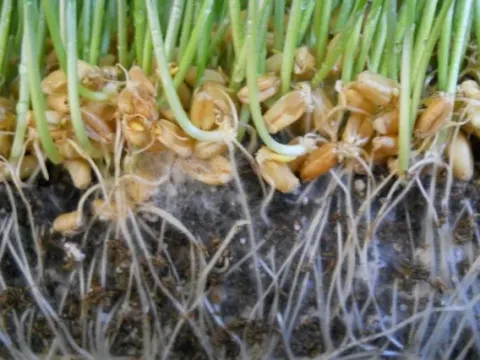
- Discoloration of seeds, which may appear darkened or coated in fungal threads.
- Clumping of seeds or stored produce due to the dense mycelial network.
- Reduced seedling vigor and potential damping-off of young plants.
Unlike some bacterial infections, the growth of Mucor is usually visible as a clear, fuzzy layer on the exterior of the host organ.
Affected tissues lose their structural integrity, making them unsuitable for market or processing even if the infected areas are removed.
Effective control starts with strict moisture management. Keeping storage relative humidity below 60% and ensuring constant air circulation is vital.
Seeds should be dried to a safe moisture content before storage and treated with appropriate fungicides to prevent early-stage decay in the soil.
Good agricultural practices, including the removal and destruction of crop residues, help limit the amount of inoculum present in the field environment.
Careful handling during harvest is essential to minimize wounds or abrasions on fruits and vegetables, as these are the primary entry points for the fungus.
Sanitizing storage facilities and machinery between seasons reduces the overall spore load, protecting the quality and shelf-life of future harvests.