
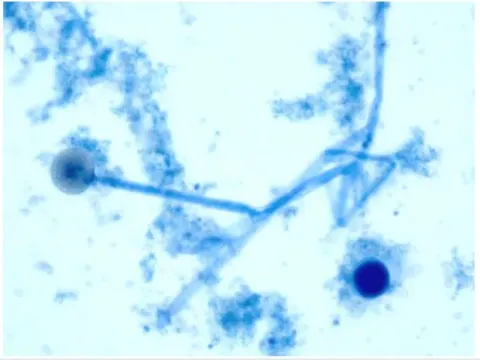
Mucor circinelloides
Mucor circinelloides
Mucor circinelloides belongs to the kingdom Fungi, phylum Mucoromycota, and genus Mucor. It is a filamentous fungus that acts as a saprotroph and a facultative parasite, capable of colonizing a wide range of organic substrates.
What the section contains
Mucor circinelloides
The fungus is characterized by rapid mycelial growth with coenocytic (non-septate) hyphae. It produces abundant sporangiophores topped with globose sporangia that release vast numbers of spores into the environment.
Mucor circinelloides exhibits high metabolic flexibility, allowing it to thrive on various plant tissues. In laboratory settings, its colonies typically display a grayish or whitish, cotton-like appearance.
Identification often requires microscopic examination of sporangiophores and spore morphology. It is commonly found in agricultural ecosystems alongside other mold species, participating in the complex decay of organic matter.
The fungus reproduces asexually with high efficiency. Its ability to produce massive amounts of spores ensures its widespread presence in agricultural soils and on crop residues.
The pathogen causes significant damage to seeds of grains and legumes, resulting in seed decay during storage or in the soil, which leads to poor germination and reduced plant stands.
Mucor circinelloides is a major cause of post-harvest soft rot in fruits and vegetables. It often enters through mechanical injuries, leading to the rapid liquefaction of host tissues.
Root crops like carrots, beets, and potatoes are highly susceptible to infection during storage if environmental conditions are not properly regulated, causing rapid degradation of the harvested produce.
In intensive cultivation, the fungus may infect weakened seedlings of vegetables such as tomatoes and cucumbers, resulting in root rot and the death of young plants.
Economic losses include not only a reduction in yield volume but also a decrease in product quality, as infected produce becomes unsuitable for market and may contain fungal toxins.
The fungus flourishes under conditions of high humidity and moderate temperatures. In the field, the risk is highest during spring when seeds are sown into cold, waterlogged soils.
In storage facilities, the pathogen can develop throughout the year if ventilation and temperature controls are inadequate. The optimal growth temperature ranges from 20 to 25 degrees Celsius.
Spores are dispersed by air currents, splashing rain, and contaminated equipment during harvesting or sorting. High moisture levels on the plant surface are essential for spore germination and infection.
Mucor circinelloides survives unfavorable periods as resting spores within the soil or on plant debris, maintaining the inoculum potential for subsequent seasons.
A peak in infection risk occurs shortly before harvest, especially during prolonged rainy periods, which weaken plant defenses and create favorable conditions for fungal penetration.
The primary symptom is the development of dense, gray or white "fluffy" mycelium on the surface of seeds, fruits, or plant tissues, which consists of masses of sporangiophores.
Infected fruits exhibit soft, watery rot, rapidly losing their structural integrity and turning into a pulpy mass. A characteristic musty or fungal odor is frequently associated with the infection.
Affected seeds show poor viability, and those that do germinate often die quickly as the fungal hyphae invade and destroy the developing root system and cotyledons.
Microscopic analysis reveals branched sporangiophores with dark sporangia that readily release spores upon physical contact, spreading the infection to adjacent healthy tissues.
The growth rate of Mucor circinelloides is exceptionally high, allowing it to colonize and cover the substrate with visible signs of disease in just a few days under conducive conditions.
Effective management begins with the use of high-quality fungicides for seed treatment to prevent soil-borne decay and ensure healthy seedling emergence.
In storage facilities, maintaining relative humidity below 75% and ensuring robust forced ventilation are critical steps to prevent the condensation that favors fungal growth.
Strict sanitation of storage rooms, packaging, and harvesting equipment is essential to reduce the overall inoculum load and prevent cross-contamination between batches.
Careful sorting during harvest to remove damaged or infected produce is vital, as a single infected fruit can serve as a primary source for an entire batch to spoil.
Implementing proper crop rotation and ensuring the deep incorporation of crop residues into the soil help to diminish the reservoir of resting spores and lower infection pressure.