
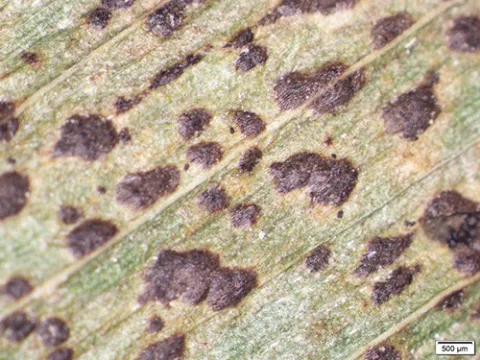
Monographella maydis
Monographella maydis
Monographella maydis is an ascomycete fungus that acts as a specialized pathogen of maize. Systematically, it belongs to the Microascaceae family. In its life cycle, this pathogen forms both conidia and a sexual stage (perithecia), which ensures its survival in soil and crop debris.
What the section contains
Monographella maydis
The fungus is the primary agent responsible for the disease known as "tar spot" complex in maize. Under high humidity, small black structures called stromata or perithecia form on the surface of infected tissues, giving leaves the appearance of being splattered with tar.
The fungus mycelium penetrates the leaf epidermis, destroying mesophyll cells. The pathogen can persist in crop residues for long periods, making these residues the main source of primary infection at the start of the growing season.
Laboratory identification involves culturing the fungus on nutrient media, where it produces colonies with characteristic morphology. PCR-based diagnostic tools allow for the rapid and precise identification of Monographella maydis among other leaf-spotting diseases.
This phytopathogen is most aggressive in regions with temperate climates and high humidity, where its spread can reach epidemic levels, causing significant yield losses in commercial corn production.
The primary host is maize (Zea mays). The fungus attacks all aerial parts of the plant, including leaf blades, leaf sheaths, and, in severe cases, the husks of the ears.
The damage manifests as the premature death of the photosynthetic leaf area. Because the photosynthetic process is impaired, the plant cannot accumulate enough assimilates to fill the grains properly.
Severe infection leads to a sharp reduction in thousand-kernel weight and poor grain development. The kernels become shriveled, which significantly reduces the market quality and nutritional value of the harvest.
Early-season infection can cause stalk lodging due to the weakening of the plant's mechanical tissues. This complicates mechanical harvesting and leads to additional yield losses in the field.
Economic losses arise not only from reduced yield but also from lower feed quality, as damaged tissues can become a substrate for the development of secondary mycotoxin-producing fungi.
Active infection starts during periods of wet weather and moderate temperatures. The optimal conditions for spore germination and tissue infection are between 18–25°C, provided there is liquid moisture on the leaves.
Conidia are spread primarily by wind and rain splashes. Initial symptoms usually appear in mid-season, once the crop canopy closes, creating a high-humidity microclimate within the field.
In hot and dry periods, the disease development slows down or stops. However, dew or nocturnal fog can sustain the pathogen's activity even when daytime temperatures are relatively high.
The grain-filling stage is considered the most critical period. During this time, the pathogen spreads actively from the lower to the upper leaves, gradually covering the entire leaf canopy.
The fungus can complete multiple cycles within a single season if environmental conditions remain favorable, leading to a rapid increase in the intensity of the disease across maize fields.
The primary sign of infection is the emergence of numerous small, black dots (stromata) that rupture the leaf epidermis. These are often surrounded by a chlorotic or necrotic halo that expands over time.
- Appearance of black dots (stromata) on leaf blades.
- Yellowing and gradual drying of leaves, starting from the lower canopy.
- Formation of irregular brown spots around the lesion zones.
- Premature plant senescence compared to healthy stands.
- Reduced ear fill resulting from the loss of photosynthetic leaf surface.
The main control measure is crop rotation. It is not recommended to plant corn in the same field more frequently than every 2-3 years to reduce the inoculum levels in the soil and residues.
Deep plowing of crop residues is an essential agronomic practice. Breaking down corn stalks accelerates the death of fungal mycelium and spores, depriving the pathogen of overwintering sites.
Using resistant hybrids is the most effective management strategy. Modern breeding programs focus on developing varieties that can limit fungal progression even under high disease pressure.
Chemical control involves the application of fungicides during epidemic-prone periods. Triazole and strobilurin class fungicides are most effective when applied preventively or upon the first signs of infection.
Weed management and maintaining optimal plant density help improve airflow within the canopy, which lowers humidity levels and hinders the rapid spread of the disease.