
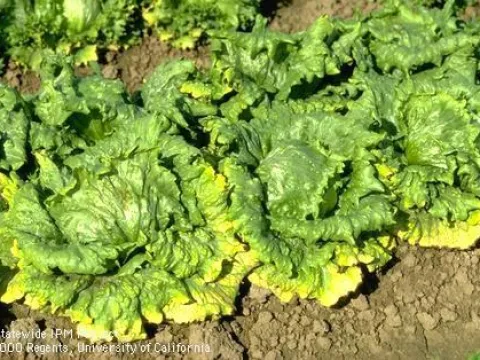
Lettuce infectious yellows
Lettuce infectious
Lettuce infectious yellows (LIYV) is caused by a virus belonging to the genus Crinivirus, family Closteroviridae. This pathogen is a significant concern for both greenhouse and field lettuce production globally, causing substantial crop failures.
What the section contains
Lettuce infectious yellows
The virus is characterized by a segmented, single-stranded RNA genome. It is not transmitted mechanically (by sap or pruning tools) or through seeds. Instead, it relies entirely on the silverleaf whitefly (Bemisia tabaci) for transmission between hosts.
The virus exhibits a semi-persistent transmission mode. This means the whitefly vector can acquire the virus after feeding on an infected plant for a short time and remain infectious for several days, spreading the pathogen throughout the field.
LIYV is limited to the phloem tissue of the host plant. This localization disrupts the movement of nutrients and sugars, causing systemic symptoms that affect the plant's overall physiology and development.
Accurate identification is typically confirmed through laboratory diagnostics, such as ELISA (Enzyme-Linked Immunosorbent Assay) or RT-PCR, as visual field symptoms can often be confused with nutritional deficiencies.
The primary host for this virus is lettuce (Lactuca sativa). However, it also has a broad host range, infecting various weeds and other crops, which act as reservoirs for the virus during the off-season.
Infected plants suffer from severe stunting and discoloration. They fail to develop marketable heads, often becoming bitter and tough. In cases of early infection, the crop is usually completely unmarketable and must be destroyed.
The economic impact can be devastating in regions where the whitefly population is high. In favorable conditions, entire fields can be lost within a short period, leading to massive financial losses for growers.
The presence of LIYV limits the ability to rotate crops effectively, especially when alternative hosts like melons or sugar beets are involved. Integrated pest management (IPM) is essential to maintain production viability.
Quality reduction is a major consequence, as the leaves lose their crisp texture and nutritional appeal. This renders the produce unsuitable for fresh market consumption, even if the plant manages to reach a harvestable size.
Symptoms generally start with interveinal chlorosis (yellowing) of the older, lower leaves. As the infection progresses, this yellowing moves upward, eventually affecting the younger leaves and the entire plant.
A distinctive feature of LIYV is the significant stunting of the plant. Infected plants appear much smaller and more compact than healthy ones. The leaves often become brittle and may roll downward, giving the plant a deformed appearance.
In later stages, necrosis (tissue death) can occur along the leaf margins. The vascular system may show signs of discoloration, further hindering the plant's ability to recover or maintain normal growth patterns.
If the infection occurs during the head-forming stage, the resulting lettuce heads are loose, immature, and lack the firmness expected in high-quality produce. These symptoms persist regardless of fertilizer application.
- Interveinal chlorosis starting on older leaves.
- Severe stunting and reduced plant size.
- Brittle leaf texture and downward leaf curling.
- Necrotic spots on leaf edges in advanced cases.
- Inability to form firm, high-quality heads.
The most critical component of LIYV control is managing the silverleaf whitefly (Bemisia tabaci) population. Without effective vector control, preventing the spread of the virus is nearly impossible.
Implement strict weed management practices around fields and greenhouses. Removing potential reservoir hosts (weeds) reduces the available food source for whiteflies and minimizes the initial viral load.
In protected cultivation, the use of fine-mesh screening on greenhouse vents is an essential physical barrier. This prevents whiteflies from entering and colonizing the crop during the vulnerable stages of growth.
Monitoring using yellow sticky traps is recommended to track whitefly density. When numbers exceed economic thresholds, appropriate systemic insecticides should be applied as part of an organized rotational program to delay resistance.
Practice crop hygiene by promptly removing and destroying infected plant material immediately upon detection. Do not leave debris in the field or greenhouse after harvest, as it can serve as a breeding ground for vectors and an inoculum source for future crops.