
Black rot of grapevine
Guignardia bidwellii
The causal agent of this disease is the fungus Guignardia bidwellii (anamorph Phyllosticta ampelicida). It is a significant pathogen classified within the Ascomycota phylum.
What the section contains
Black rot of grapevine
The fungus overwinters in the form of mycelium and fruiting bodies (pycnidia and perithecia) within infected vine canes, mummified berries, and leaf debris remaining on the trellis.
Primary infection occurs in early spring when spores are released and dispersed by rain splashes or wind onto developing leaves and shoots of the grapevine.
The disease development is highly dependent on environmental conditions, specifically moisture duration and temperature, favoring fungal penetration into host tissues.
As the season progresses, secondary infection cycles occur via conidia, leading to exponential spread throughout the vineyard if humidity remains high.
Black rot is a devastating disease for Vitis vinifera and native grape species, capable of destroying the entire crop if not managed properly.
Infection results in reduced photosynthetic area due to leaf damage, poor shoot development, and direct loss of grape clusters before harvest.
The pathogen causes significant damage to the peduncles, leading to the withering of grape clusters and subsequent fruit drop during the ripening phase.
Long-term impact on the vine includes cane death, reduced cold hardiness, and an overall decline in plant vigor over successive growing seasons.
Economic losses are compounded by the necessity of increased fungicide applications and the potential for total crop loss in poorly managed vineyards.
Leaf symptoms appear as small, circular, reddish-brown spots that gradually expand and develop a distinct dark border with a lighter center.
Shoot infections present as elongated black lesions which can cause deep cracks in the bark, potentially leading to girdling of the young wood.
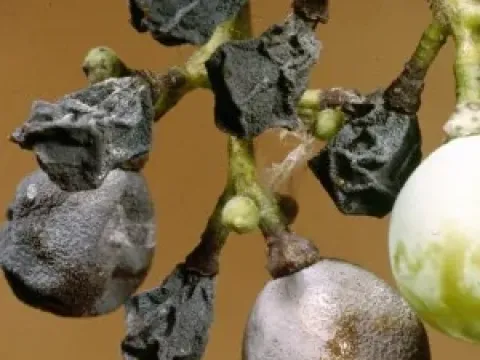
Berry infection begins as small white-to-light-brown spots that enlarge rapidly, causing the berry to collapse and turn into a shriveled, black, hard mummy.
Tiny black structures, known as pycnidia, become visible on the surface of necrotic spots on leaves, shoots, and especially on the shriveled berries.
- Reddish-brown necrotic leaf spots.
- Black pycnidia scattered on lesions.
- Hard, shriveled, black mummified berries.
- Elongated lesions on green shoots.
Sanitation is the cornerstone of black rot control; removing all mummified berries and pruning infected wood helps reduce the primary inoculum load.
Canopy management, such as timely leaf thinning and shoot positioning, is vital to improve airflow and reduce humidity levels within the vine structure.
Chemical control involves a preventive spraying program starting from bud break, using both protective contact fungicides and effective systemic products.
Timing the applications before predicted rain events is crucial, as the fungus requires prolonged leaf wetness to initiate the infection process.
Integrating resistant or tolerant grape cultivars into the vineyard design provides a long-term sustainable solution for minimizing disease pressure.