
Coffee leaf rust
Hemileia vastatrix
The causative agent of this disease is the microscopic fungus Hemileia vastatrix, a member of the Basidiomycota division and the Pucciniales order. It is an obligate parasite that requires living host tissue to survive.
What the section contains
Coffee leaf rust
Unlike many other rust fungi, it does not produce typical aecia or pycnidia. The disease cycle is primarily driven by urediniospores, which serve as the primary inoculum for rapid spread.
The urediniospores are reniform or ovoid and possess distinct spines on their convex surface, which are adaptations for wind dispersal and adhesion to leaf surfaces.
This pathogen is considered one of the most destructive and highly specialized fungi, capable of causing devastating epiphytotics in tropical coffee-growing regions worldwide.
The infection process begins when a spore germinates on the leaf surface, and the germ tube enters the leaf through the stomata to colonize the intercellular space.
The primary host for Hemileia vastatrix is the coffee tree, with the commercially significant Coffea arabica being particularly susceptible to the infection.
The fungus primarily attacks the leaves, though severe infestations can spread to leaf petioles, leading to significant defoliation and weakening of the plant.
Reduced leaf area dramatically limits the photosynthetic capacity of the tree, which is essential for fruit development and berry maturation.
Plants weakened by heavy infection fail to provide enough nutrients for cherry development, often resulting in premature fruit drop and poor bean quality.
Long-term damage includes the dieback of productive branches, causing a substantial reduction in yields that can last for several growing seasons.
The development of coffee leaf rust is strictly dictated by climatic conditions, especially the availability of free moisture on the leaf surface, which is required for spore germination.
The spread of the disease is most intense during prolonged rainy seasons and under conditions of high relative humidity, typically exceeding 80%.
The optimal temperature range for spore germination and mycelial growth is between +21°C and +25°C, mirroring the conditions in most tropical coffee plantations.
The disease cycle often hits its peak at the start of the wet season, when moisture levels facilitate the release and germination of accumulated spores.
Dispersal within a plantation occurs via rain splash, wind currents, and mechanical transmission through contaminated farm equipment or worker clothing.
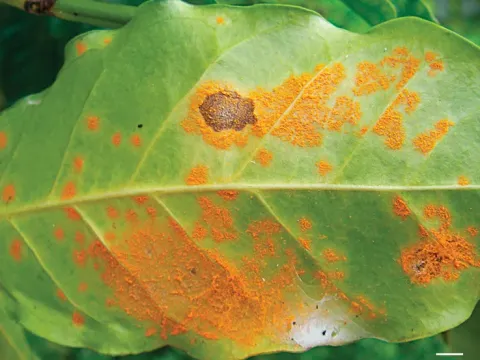
Initial symptoms are characterized by small, pale yellow chlorotic spots appearing on the undersides of the leaves as the fungus colonizes the internal tissue.
As the infection progresses, these spots develop into a powdery, bright orange to rust-colored fungal pustule consisting of thousands of urediniospores.
Corresponding chlorotic or necrotic lesions appear on the upper surface of the leaves, marking the sites where the fungus has penetrated and damaged the tissue.
Over time, these lesions coalesce, covering large portions of the leaf blade, which subsequently leads to leaf necrosis and premature shedding.
- Pale yellow chlorotic spots
- Orange-colored powdery pustules
- Early leaf drop and defoliation
- Dieback of stems and branches
The most effective strategy for managing coffee leaf rust is the development and cultivation of resistant or tolerant coffee varieties.
Preventative applications of copper-based fungicides remain the standard industrial control method for protecting healthy crops in high-risk areas.
Agronomic practices, including systematic pruning, are crucial for improving air circulation within the canopy, which reduces the moisture levels favored by the fungus.
Proper density management and shade control are vital to prevent the creation of a microclimate that encourages rapid fungal reproduction.
Implementation of early-warning monitoring systems allows for precise, localized interventions, helping to prevent widespread contamination across the plantation.