
Coconut cadang-cadang
Coconut cadang-cadang
The causative agent of the disease is the Coconut cadang-cadang viroid (CCCVd). It is a highly infectious, sub-viral pathogen consisting of a small, circular, single-stranded RNA molecule without a protein capsid.
What the section contains
Coconut cadang-cadang
It belongs to the genus Cocadviroid, family Pospiviroidae. Unlike viruses, viroids do not encode proteins and rely entirely on host cell enzymes for their replication and pathogenesis.
The viroid genome is highly adaptable, exhibiting significant genetic diversity, which allows it to infect various palm species and persist in different environmental conditions.
Identification in the field is impossible due to the sub-microscopic size of the agent. Molecular diagnostic techniques, such as RT-PCR and nucleic acid hybridization, are required for accurate detection.
The disease was first identified in the Philippines and represents one of the most significant threats to coconut production in Southeast Asia and the Pacific regions.
The primary host is the coconut palm (Cocos nucifera). The viroid infects trees of all ages, although severe symptoms are typically observed in palms over ten years old.
Beyond coconut palms, the viroid can infect other species, including the oil palm (Elaeis guineensis) and the areca nut palm (Areca catechu), increasing the risk of transmission to other industrial crops.
Infection results in the total loss of palm productivity. As the viroid colonizes the host, it disrupts cellular metabolism, leading to stunted growth and eventual tree death.
The cumulative economic impact is immense, with millions of trees destroyed since the disease was first documented, leading to the collapse of local coconut economies.
By interfering with gene expression in the host, the viroid causes systemic physiological failure, eventually exhausting the plant's capacity to maintain vascular and structural integrity.
Initial symptoms include the appearance of small, yellow, chlorotic spots on the leaf surface, which gradually increase in size and density over several years.
A decline in nut production is an early indicator of infection. Initially, nuts become smaller, then misshapen, and eventually, the palm stops producing flowers entirely.
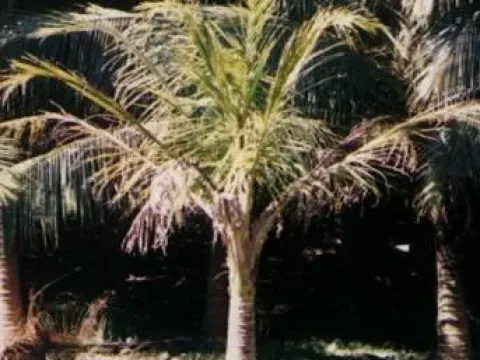
As the disease progresses, leaves become progressively smaller, stiffer, and distorted, leading to a thin, sparse crown which is a hallmark of the advanced stage of infection.
The trunk of the palm often tapers at the apex, becoming noticeably thinner than the lower sections, which serves as a visual diagnostic marker for agricultural inspectors.
The final phase ends with the death of the crown, leaving behind a barren trunk. The entire process from infection to death can take between 8 to 16 years.
There are no known chemical or biological treatments capable of curing a palm once it is infected with the Coconut cadang-cadang viroid.
The standard management practice is the systematic removal and destruction of infected palms to limit the spread of the pathogen to healthy neighboring trees.
Strict quarantine measures on the movement of seed nuts and planting material are essential to prevent the introduction of the pathogen into non-infested regions.
Farm hygiene is crucial, particularly the sterilization of harvesting and pruning tools, as mechanical transmission through contaminated blades is a known pathway for spread.
Agricultural research is focused on developing viroid-resistant coconut varieties, although progress is slow due to the long generation times and complex genetics of the coconut palm.