
Coffee leaf rust (Hemileia coffeicola)
Hemileia coffeicola
Hemileia coffeicola is a pathogenic fungus belonging to the order Pucciniales. It is a highly specialized obligate parasite that specifically infects plants of the genus Coffea.
What the section contains
Coffee leaf rust (Hemileia coffeicola)
As a basidiomycete, it completes its life cycle by infecting coffee leaves and producing spores that serve as primary and secondary inoculum for further spread.
The mycelium of the fungus develops intercellularly, eventually erupting through the stomata on the lower surface of the leaves to produce spore masses.
It is distinguished from the more globally recognized Hemileia vastatrix by specific ecological preferences and distinct morphological characteristics of its urediniospores.
The presence of this pathogen is primarily documented in specific coffee-growing regions in Africa, where environmental conditions support its long-term persistence.
The fungus attacks the foliage of coffee trees, causing significant disruption to the plant's photosynthetic process and energy metabolism.
Infection leads to severe defoliation, which causes the tree to lose its ability to synthesize enough nutrients to support berry development and vegetative growth.
The economic impact is manifested in a substantial decrease in coffee yields and the deterioration of bean quality, making the harvested product less valuable.
Persistent infestations weaken the trees over successive seasons, increasing their susceptibility to secondary pathogens and reducing the overall lifespan of the plantation.
In extreme cases of infestation, young plantations can experience stunted growth or total failure, necessitating expensive replanting and restoration efforts.
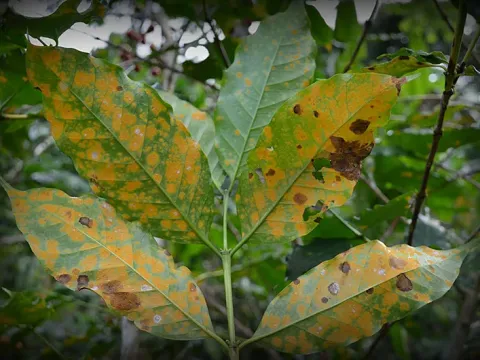
The initial signs of infection include small, yellow to orange spots appearing on the abaxial (lower) side of the leaves, corresponding to the site of fungal emergence.
These spots enlarge and become covered in a characteristic powdery deposit, which consists of masses of urediniospores that are easily disseminated by wind and water droplets.
On the adaxial (upper) side of the leaves, chlorotic areas appear, eventually turning into necrotic or brown spots as the leaf tissue dies off due to fungal colonization.
Infection typically initiates in the lower, more sheltered parts of the canopy, where moisture levels and humidity remain higher for extended periods.
During the advanced stages of the disease, leaves turn yellow and drop prematurely, leaving branches bare and exposing berries to direct sunlight, which further reduces quality.
Chemical control remains a primary strategy, utilizing copper-based fungicides to inhibit spore germination and protect the leaf surface from new infections.
Pruning and canopy management are critical cultural practices that improve airflow and light penetration, effectively creating a less favorable environment for the pathogen.
Selecting and planting genetically resistant coffee varieties is the most sustainable approach to managing the disease and minimizing reliance on chemical sprays.
Sanitation practices, including the removal and destruction of infected leaf litter, are essential to reduce the primary inoculum load within the plantation environment.
Regular monitoring of plant health allows for early detection of disease outbreaks, enabling precise and localized fungicide applications to contain the spread.