
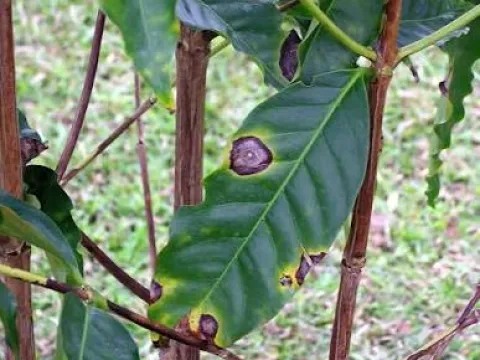
Coffee cercospora leaf spot
Cercospora coffeicola
The causal agent of this disease is Cercospora coffeicola, a pathogenic fungus that belongs to the phylum Ascomycota. It is a highly specialized parasite that affects various Coffea species globally.
What the section contains
Coffee cercospora leaf spot
The fungus produces hyaline to olive-colored conidia on specialized conidiophores. These asexual spores are primarily disseminated by splash water during heavy rains and wind, facilitating the rapid spread of the pathogen within the canopy.
The life cycle of Cercospora coffeicola involves both parasitic and saprophytic stages. It persists in infected plant debris, including fallen leaves and mummified berries left on the trees after harvesting, serving as a primary inoculum source.
Environmental factors such as high humidity, dew, and moderate temperatures ranging from 20°C to 28°C are optimal for fungal growth. Water film on the plant surface is essential for spore germination and tissue colonization.
The fungus penetrates the leaf or berry tissues through natural openings like stomata or microscopic cracks in the cuticle. Once inside, it secretes toxins that lead to tissue death and the formation of characteristic spots.
The pathogen causes significant economic loss by reducing both the quantity and quality of the coffee yield. Severe foliage infection leads to heavy defoliation, which causes dieback of branches and exhaustion of the plant's reserves.
Infection of the berries, commonly referred to as "brown eye spot," results in necrosis of the pericarp. This damage prevents the proper development of the seeds, leading to lower cup quality and significant weight loss in the harvested coffee.
Leaf symptoms appear as circular to irregular spots, typically brown with a pale or grayish center. Under high humidity conditions, a velvety dark-gray or black sporulation layer becomes visible in the center of these lesions.
On the berries, symptoms manifest as small, sunken, dark brown or black lesions. These spots can expand to cover the entire fruit surface, often resulting in premature berry drop or drying out of the beans while still on the branch.
Integrated pest management strategies are crucial. Regular pruning of the coffee trees is recommended to improve air circulation and light penetration, which reduces the moisture levels necessary for fungal development.
Chemical control involves the application of copper-based fungicides or systemic triazoles. These treatments should be timed with the peak of the rainy season or during the critical phases of berry development to minimize infection impact.