
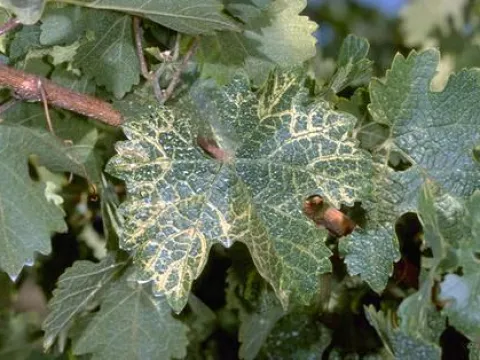
Grapevine asteroid
Grapevine asteroid
Grapevine asteroid is a specialized phytopathogen that causes systemic viral infection in grapevines. It is identified by its unique impact on the host's vascular system, leading to characteristic morphological changes in leaves and shoots.
What the section contains
Grapevine asteroid
Systematically, this pathogen is classified as a virus that utilizes soil-borne nematodes as vectors. This mode of transmission is crucial for understanding its presence and management in viticulture, as it restricts the movement of the disease across non-contiguous soil patches.
Diagnostic identification typically involves laboratory techniques, as visual symptoms can sometimes be confused with nutrient deficiencies. Enzyme-linked immunosorbent assay (ELISA) and polymerase chain reaction (PCR) are the standard procedures for confirming the presence of this viral agent.
The name "asteroid" refers to the specific star-shaped chlorotic patterns that develop on the leaves, which serve as a primary indicator for field identification. These distinct patterns facilitate early detection by trained agronomists during scouting operations.
The pathogen is not airborne, which differentiates it from fungal diseases. Its stability within the soil environment and root systems requires a strategy focused on site-specific sanitation and rigorous monitoring of soil health.
Grapevine asteroid primarily targets Vitis vinifera, causing severe systemic stress. The damage is cumulative, leading to the long-term decline of vineyard productivity and the eventual loss of affected vines.
The pathogen disrupts the transport of nutrients within the plant, which negatively affects berry development. Harvested fruit from infected vines often displays poor sugar accumulation and undesirable acidity, significantly lowering the commercial value of the crop.
Increased susceptibility to secondary infections and environmental stressors is a common consequence of infection. Plants weakened by the virus are less capable of surviving cold winters, leading to patchiness in the vineyard.
Economic losses are profound, as the infection generally necessitates the removal and destruction of the affected blocks. The inability to cure the virus makes replanting with certified, disease-free stock the only viable long-term solution.
In addition to yield loss, the pathogen reduces the life expectancy of the vineyard, requiring earlier-than-planned renewal of the entire planting, which creates a substantial financial burden for the grower.
The life cycle of the Grapevine asteroid is intrinsically linked to the grapevine's vegetative cycle. Infection processes and viral replication are most active during the spring when the plant's sap flow is at its peak.
Signs of infection often appear during the early growth stages, coincident with the increased activity of nematode vectors in the soil. Consistent monitoring during the spring and early summer is essential for detecting early symptoms.
The warm summer months promote the rapid spread of the virus within the plant tissue. The symptoms become more pronounced as the plant directs more energy towards canopy development and fruit maturation.
During the autumn, the virus becomes less active but persists in the woody tissues and roots, ensuring its survival during dormancy. This allows the pathogen to remain in the host throughout the winter.
Because the pathogen persists in the soil via nematodes, it can survive for several years even after the vine is removed, provided the root debris remains in the soil. This creates a significant risk for new plantings established on the same site.
The visual symptoms of Grapevine asteroid are distinct, primarily manifesting as structural deformities in the plant's foliage and growth patterns.
- Star-shaped chlorotic blotches on leaf surfaces;
- Asymmetric development of leaf blades;
- Significant shortening of shoot internodes;
- Stunted growth leading to a bushy appearance;
- Irregular ripening of berries within a single bunch.
A classic sign is the reduced distance between nodes, often described as "short-node" syndrome. This structural change inhibits the vine's ability to maintain a healthy and vigorous canopy, directly impacting photosynthetic efficiency.
During fruit maturation, infected vines show uneven berry sizing, where small, green, and undeveloped berries persist alongside mature ones. This lack of uniformity is a reliable diagnostic feature for identifying the disease in the field.
Prevention through the use of certified virus-free rootstock and scion wood is the most effective management strategy. Rigorous screening of planting material is mandatory to prevent the introduction of the pathogen to a clean site.
Controlling the nematode population is vital for reducing the risk of viral spread. Techniques such as soil fumigation or the use of specific cover crops can help manage vector numbers before vineyard establishment.
If an infection is detected, the affected vines must be removed immediately, including their entire root systems. Simply pruning the aerial parts is ineffective, as the virus persists in the roots.
Phytosanitary practices, including disinfecting tools used in the vineyard, are essential to prevent the mechanical transmission of the pathogen between vines during routine maintenance.
Regular site scouting and laboratory testing are critical components of a successful control program, allowing for early detection and isolation of infected areas before the disease becomes widespread across the entire vineyard.