
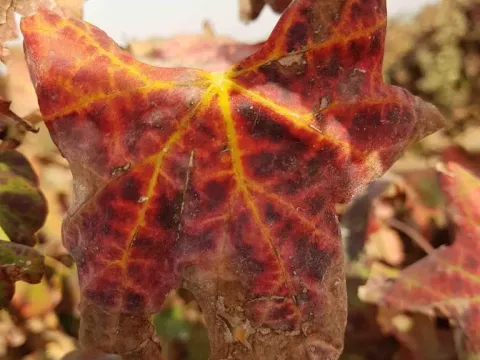
Grapevine leafroll disease
Grapevine leafroll-associated
Grapevine leafroll disease is caused by a complex of viruses known as Grapevine leafroll-associated viruses (GLRaV), typically belonging to the Ampelovirus genus within the Closteroviridae family. It is one of the most economically damaging viral diseases in viticulture worldwide.
What the section contains
Grapevine leafroll disease
The virus particles are thread-like and contain single-stranded RNA. They are transmitted primarily through infected vegetative propagation material, such as cuttings and rootstocks, making nurseries a critical point for disease management.
In addition to vegetative spread, the virus is efficiently transmitted in the field by several species of mealybugs (Pseudococcidae) and soft scales (Coccidae). These insects feed on the phloem of the vine, ingesting and spreading the virus particles.
Once infected, a vine remains a carrier for its entire life. The virus localizes in the phloem tissue, obstructing the translocation of carbohydrates, which leads to physiological imbalances within the plant structure.
Detection is difficult during the early stages, as the virus can remain latent for extended periods. Modern diagnostic techniques such as ELISA and RT-PCR are essential for certifying virus-free vineyard stock.
The primary economic impact of leafroll disease is a significant reduction in both yield and grape quality. The clusters often become loose, and the berries exhibit uneven ripening and lower sugar accumulation.
Because sugar transport is inhibited, the wood of the vine fails to lignify properly, making the plant highly susceptible to winter injury and cold temperatures. This drastically shortens the productive lifespan of the vineyard.
Quality in winemaking is compromised as the must has lower sugar content and altered anthocyanin levels, affecting color and flavor profiles. Consequently, grapes from infected vines are often rejected by premium wine producers.
The overall vigor of the grapevine is suppressed, leading to stunted shoot growth and reduced root development. This creates a cycle of degradation where the vine becomes increasingly unproductive over several years.
In mature vineyards, the spread of the virus from vine to vine by insect vectors can lead to the necessity of replanting entire blocks, causing massive financial losses for growers.
The hallmark symptoms usually emerge in mid-to-late summer, starting with the curling of the margins of the basal leaves downward. This rolling creates a characteristic cup-like appearance of the leaf blade.
In red-berried varieties, the leaf tissue between the veins turns distinctively red or purple, while the primary veins remain green. This creates a strong color contrast that is highly visible during the autumn season.
In white-berried cultivars, the leaf discoloration is typically chlorotic, turning light yellow or pale green. Despite the color difference, the physical curling of the leaves remains a consistent diagnostic feature.
- Downward rolling of leaf margins
- Interveinal reddening or yellowing
- Delayed phenology and poor fruit maturation
- Reduced sugar levels (Brix) in berries
- Premature leaf drop in late autumn
It is important to distinguish these symptoms from other issues like nutritional deficiencies (e.g., magnesium deficiency) or crown gall, which may produce different patterns or lack the persistent rolling characteristic of the virus.
The most effective strategy is the exclusive use of certified virus-tested planting material. Growers should only source vines from nurseries that adhere to strict virus-elimination protocols.
Implementing a rigorous mealybug and scale insect control program is vital to prevent the secondary spread of the virus within the vineyard. Regular monitoring for these pests during the growing season is recommended.
Prompt roguing is necessary: any vine displaying symptoms should be removed and destroyed. Leaving infected vines in the field guarantees further transmission to healthy neighboring plants.
Strict sanitation protocols must be applied during pruning and grafting. All tools should be disinfected between plants using appropriate chemical agents to avoid mechanical transfer of the virus via sap.
Establishing buffer zones and maintaining the surrounding area free from alternate host weeds can reduce the population of vectors. Continuous vigilance and regular laboratory testing are cornerstones of sustainable vineyard health.