
Powdery mildew of stone fruits
Podosphaera tridactyla
Description
How to identify
The pathogen Podosphaera tridactyla belongs to the kingdom Fungi, phylum Ascomycota, and class Leotiomycetes. It is a highly specialized obligate parasite responsible for the disease known as powdery mildew on stone fruit trees.
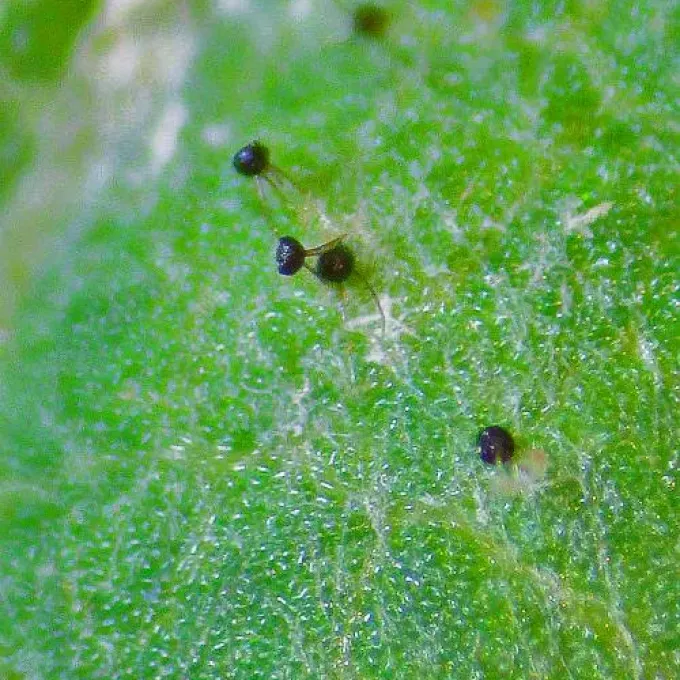
The fungus develops primarily on the surface of plant organs, creating a light, powdery coating consisting of mycelium and conidial spores. To identify the species under a microscope, it is necessary to examine the morphology of the cleistothecia, which possess characteristic appendages.
Systematically, this pathogen is closely related to other members of the order Erysiphales. It is considered one of the most common powdery mildew agents affecting trees within the genus Prunus.
The pathogen demonstrates significant adaptability to various climatic conditions within temperate zones. Its life cycle involves alternating asexual sporulation (conidia) and sexual reproduction (ascospores in asci), ensuring long-term survival.
The pathogen undergoes multiple generations within a single growing season, allowing it to spread rapidly across large orchard areas when environmental conditions are conducive to development.
What it damages
The primary hosts for this fungus are species of the genus Prunus, including cherries, sweet cherries, and to a lesser extent, plums, peaches, and apricots. Some ornamental shrubs can also be affected.
The fungus attacks almost all green parts of the plant: leaves, young shoots, petioles, and fruits. Infection is particularly dangerous in nursery saplings, where it can cause stunted growth or complete plant failure.
Damage to stone fruits results in deformation, cracking, and a significant decrease in marketability. Affected fruits lose their flavor and become highly susceptible to storage rots and transport damage.
Infected leaves curl prematurely, yellow, and drop. This disrupts essential photosynthetic processes, which significantly reduces the tree's overall productivity and its ability to withstand cold winter temperatures.
Severe infestation of shoots causes deformation, shortened internodes, and dieback of the tips. These affected shoots often fail to harden off properly, making them highly vulnerable to frost damage in winter.
When it appears
Primary infection in spring occurs through ascospores that overwintered in cleistothecia on fallen leaves or in the bark of infected shoots. Additionally, the fungus can survive as mycelium within dormant buds.
Active conidial spread begins with the onset of warm, humid weather. The optimal temperature for spore germination ranges from +18 to +25 degrees Celsius, provided there is sufficient air humidity.
Disease outbreaks are most frequent during periods of fluctuating temperatures and high humidity, which are characteristic of late spring and early summer.
By mid-summer, the rate of spore dispersion peaks, covering new sections of the canopy. During this phase, secondary infections occur in rapid succession, with intervals of only 5–7 days between cycles.
As autumn approaches, the fungus develops cleistothecia for overwintering. At this stage, the production of conidia gradually declines, and the pathogen transitions into a dormant state until the following season.
Signs of infestation
The first sign of infection is the appearance of a white, powdery coating on the undersides of young leaves. Gradually, this growth expands and becomes visible on both sides of the leaf blade.
Infected leaves become brittle, and their edges curl upward, resembling a small boat. In areas of heavy infection, the leaf tissue may show necrotic spots.
On young shoots, the fungal growth is often dense and felt-like. Affected sections of the stem take on a brown discoloration and may twist or bend as they attempt to continue growing.
When fruits are affected, whitish patches form on the surface, which eventually become rough and develop into corky scabs. Such defects not only spoil the appearance but also invite secondary rots.
- Appearance of white, spider-web-like fungal growth.
- Curling and deformation of young leaves.
- Twisting and growth retardation of young shoots.
- Cracking and corky scarring of fruit skin.
- Premature leaf drop in mid-summer.
Control measures
Cultural practices include the mandatory collection and destruction of fallen leaves, as well as pruning and burning infected shoots. Proper orchard management, including thinning the canopy, is vital for air circulation.
Selecting varieties resistant to powdery mildew is a key component of integrated pest management. Growers should prioritize planting certified cultivars adapted to local environmental conditions.
Chemical control involves the use of fungicides from various chemical groups. Systemic triazole-based products are particularly effective at suppressing mycelial growth within plant tissues.
For preventative measures, applying contact-based sulfur products before and after the flowering stage is highly recommended. These create a protective barrier that inhibits the germination of fungal spores.
In modern protection programs, it is essential to rotate fungicides with different modes of action to prevent the development of resistance within Podosphaera tridactyla populations.
Causes diseases · 1
Discussion
No discussions yet — be the first.