
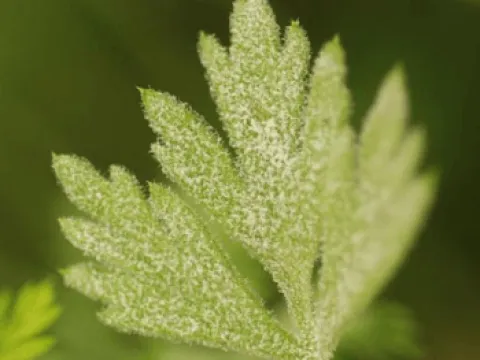
Powdery mildew of umbellifers
Erysiphe heraclei
Powdery mildew of umbellifers is caused by the obligate fungal pathogen Erysiphe heraclei. This fungus belongs to the order Erysiphales and is a specialized parasite that colonizes the surface of host plant tissues, utilizing haustoria to extract nutrients from epidermal cells.
What the section contains
Powdery mildew of umbellifers
The pathogen reproduces via conidia, which are wind-dispersed, allowing for rapid spread across agricultural fields. It survives harsh conditions by producing cleistothecia, which are small, dark, overwintering fruiting bodies that remain in soil or on infested plant debris.
Under favorable environmental conditions, the fungus initiates a polycyclic development, meaning multiple generations of conidia can be produced within a single growing season. This ensures that the disease pressure increases exponentially if not managed correctly.
Identification is confirmed through microscopic analysis of conidial chains and cleistothecia morphology. In the field, the disease is visually identified by a characteristic white, mycelial growth covering the affected foliage, often resembling a dusting of flour.
Because it is an obligate parasite, Erysiphe heraclei requires living host tissue to complete its life cycle. It specifically targets plants within the Apiaceae family, including economically important crops such as carrots, celery, and parsnips.
The primary hosts of this fungus include carrot, parsley, celery, parsnip, dill, and coriander. The infection covers stems, petioles, and leaves, significantly impairing the plant's ability to conduct photosynthesis effectively.
Infected leaves exhibit yellowing (chlorosis), curling, and eventually necrosis. As a direct result of impaired photosynthesis, the development of storage organs, such as carrot roots, is severely restricted, leading to significant yield losses.
For seed production crops, the damage is particularly severe as the pathogen attacks inflorescences and flower stalks. This leads to poor seed set, reduced seed weight, and lower overall germination rates in the subsequent harvest.
Economic damage is twofold: quantitative yield loss due to reduced root size and qualitative loss due to poor appearance and susceptibility to secondary rot pathogens. Stored carrots from infected fields are often prone to post-harvest decay.
Severely affected plants show signs of stunted growth and a collapsed canopy. This loss of foliage vigor not only impacts the current harvest but also complicates mechanical harvesting, as the stems become brittle and break easily.
The disease typically emerges during mid-to-late summer when temperatures range between 18°C and 25°C. High relative humidity, often induced by nocturnal dew or dense canopy foliage, creates an ideal environment for spore germination.
Epidemics often coincide with the stage of canopy closure. The stagnant air inside dense foliage allows for increased humidity levels, which facilitates the establishment and rapid colonization of the fungus on lower, older leaves first.
Secondary infections occur in rapid cycles, with new spores maturing every 7–10 days under optimal conditions. This timing means that a few initial infection sites can result in a field-wide outbreak within a matter of weeks.
As the growing season concludes and day length shortens, the fungus begins producing cleistothecia. These structures are designed for survival and will remain dormant until the following spring, restarting the disease cycle.
Agronomists monitor weather patterns closely, as sudden shifts from hot, dry weather to cool, humid nights can trigger sudden outbreaks of powdery mildew in susceptible umbelliferous crop stands.
The first symptoms appear as small, isolated white spots on the upper leaf surfaces. As the mycelial mat expands, these spots coalesce, eventually covering the entire leaf blade and spreading to the leaf undersides.
As the mycelium thickens, it takes on a dusty or greyish appearance. The emergence of tiny, pepper-like black dots within the white mat indicates the presence of cleistothecia, marking a transition toward the sexual stage of the fungus.
Leaves affected by the disease lose their structural integrity, turning brittle and chlorotic. Eventually, the tissues dry out and turn brown, leading to premature leaf drop and a significant reduction in the photosynthetic surface area.
Stalks and stems may also show white powdery coatings, often leading to lodging or bending. This structural weakness in the aerial parts is a clear indicator that the plant is under severe stress due to the fungal infection.
Diagnosis is simple in the field because the white mycelium is superficial. However, the ease of spore detachment upon disturbance is a major factor in the disease's ability to spread throughout a crop field rapidly.
A successful control strategy utilizes an Integrated Pest Management (IPM) approach. A critical cultural practice is the implementation of a 3- to 4-year crop rotation, which prevents the buildup of the pathogen in the soil.
Sanitation is equally vital. Deep plowing of crop residues helps bury infested material, promoting the decomposition of cleistothecia. Controlling wild Apiaceae weeds in field margins reduces the potential primary inoculum sources.
Chemical control should be proactive. Applying fungicides such as triazoles or strobilurins early at the first sign of infection is essential to prevent the disease from becoming established throughout the crop canopy.
Maintaining balanced soil fertility, with particular attention to potassium and phosphorus levels, improves host plant vigor. Stronger cell walls in well-nourished plants are generally more resistant to the penetration of fungal haustoria.
Choosing resistant or tolerant cultivars is the most sustainable management method. Growers should source seeds from reputable suppliers who prioritize phytosanitary standards to ensure the planting material is free from seed-borne inoculum.