
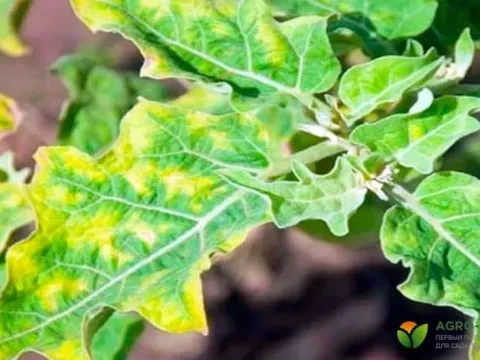
Eggplant mottled
Eggplant mottled
The causative agent of the disease is the Eggplant mottled virus, belonging to the genus Tobamovirus or Potyvirus. These are small phytopathogenic agents that penetrate plant cells, causing systemic infection.
What the section contains
Eggplant mottled
The virus is an obligate parasite, incapable of reproducing outside of living host tissues. It exhibits high stability in plant debris and soil.
Vectors of the infection are most often insects with piercing-sucking mouthparts, such as aphids and thrips, as well as mechanical transmission via gardening tools.
The viral particle can persist in seeds, making planting material the primary source of initial infection in new areas.
Systematically, the object belongs to the group of RNA viruses capable of rapid mutation and adaptation to environmental conditions.
The disease primarily affects plants of the Solanaceae family. The main host is the eggplant, but the virus can also infect tomatoes, peppers, and potatoes.
The virus causes severe damage to greenhouse operations and open-field crops, reducing the commercial value of fruits and overall crop yield.
Secondary hosts include many weed species that serve as reservoirs for the virus during the off-season.
Infection of vegetable crops leads to significant stunting of plants and the development of chlorotic zones on leaves.
Damage by the viral pathogen makes the plant susceptible to secondary infections, including fungal and bacterial diseases.
The primary symptom is the appearance of a characteristic mosaic pattern on the leaves, consisting of alternating light green and dark green areas.
Leaf blades may become deformed, curled, and acquire a thread-like shape, which significantly reduces the photosynthetic surface area.
Irregular spots form on the eggplant fruits, and sometimes the surface becomes bumpy, rendering them unsuitable for market sale.
Plants infected at early stages remain stunted and produce almost no fruit during the active growth period.
As the disease progresses, necrosis of individual stem sections and premature flower drop are observed.
The main method of control is the use of certified healthy planting material free from viral infections.
Strict adherence to phytosanitary rules is necessary: remove and destroy infected plants by the root, preventing them from entering the compost.
Controlling the population of insect vectors, such as aphids, is critical for preventing the spread of the virus within the crop.
Regular disinfection of gardening tools with potassium permanganate solutions or specialized antiseptics reduces the risk of mechanical transmission.
- Crop rotation, excluding solanaceous crops for 3-4 years.
- Regular weeding of reservoir weeds.
- Usage of resistant eggplant hybrids.