
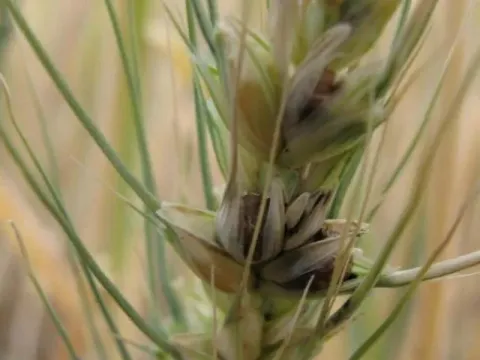
Dwarf bunt of wheat
Iranian wheat
Dwarf bunt is caused by the fungus Tilletia controversa, a highly specialized pathogen belonging to the order Ustilaginales. It is a soil-borne disease that primarily affects winter cereals, specifically winter wheat, in regions with cold, moist winters.
What the section contains
Dwarf bunt of wheat
The pathogen is classified within the Basidiomycota division. Its life cycle is unique because it requires a specific period of cold, wet conditions for teliospore germination, which usually occurs after the plants have emerged in autumn and are covered by snow.
The teliospores of Tilletia controversa are extremely persistent and can remain viable in the soil for up to a decade. This long-term survival makes the disease notoriously difficult to eradicate once a field is contaminated.
Infection begins when spores germinate in the soil under a snow cover at temperatures between 1 and 5 degrees Celsius. The fungus penetrates the young seedling and colonizes the plant systemically as it grows throughout the winter and spring.
The disease is distinct from common bunt due to its systemic nature and its specific environmental requirements for infection, leading to localized but intense outbreaks in specific climatic zones.
Winter wheat is the primary host for dwarf bunt. The infection leads to significant reductions in grain yield and quality, as the pathogen redirects nutrients to produce fungal spores instead of wheat kernels.
The most characteristic sign of damage is severe dwarfing. Infected plants exhibit significantly shortened internodes, often reaching only 25–50% of the height of healthy plants in the same field.
The heads of infected plants are often deformed and may fail to emerge fully from the boot. Inside the glumes, the developing ovaries are replaced by hard, spherical or oval-shaped bunt balls filled with a dense, black mass of teliospores.
Grain quality is severely compromised; the contaminated grain releases a strong, unpleasant "fishy" odor caused by trimethylamine, rendering the harvest unsuitable for milling or livestock feed.
Direct economic losses result from both yield suppression and the total rejection of infected grain batches by markets. In severe cases, farmers may be forced to plow under the entire crop if infection levels are too high.
Symptoms are most visible during the heading and grain-filling stages. Infected plants can be easily identified by their stunted appearance and irregular, bushy growth habits.
Plants infected with dwarf bunt display excessive tillering, producing a large number of unproductive, stunted shoots. This creates a "tufted" or "brush-like" appearance in the field compared to the uniform height of healthy stands.
The heads of affected wheat are often darker and remain green longer than healthy heads. When broken, the bunt balls release a dark, powdery cloud of spores that easily contaminates the soil and harvesting equipment.
The bunt balls themselves are typically more compact and harder than those found in common bunt, and they generally persist in the heads until mechanical harvesting breaks them apart.
- Extreme stunting of the plant height.
- Extensive, unproductive tillering.
- Deformed heads containing black bunt balls.
- Unpleasant fishy odor in the harvested grain.
- Delayed maturity compared to surrounding healthy plants.
The most effective strategy for managing dwarf bunt is the use of resistant wheat cultivars. Plant breeders continuously work to identify and incorporate resistance genes into commercial varieties.
Cultural practices, such as crop rotation, are essential. Rotating away from winter wheat for at least three to four years helps to reduce the concentration of teliospores in the soil, although the long viability of the pathogen limits the total effectiveness of this method.
Seed treatment with systemic fungicides is crucial for protecting the seedling in the early stages of development. Active ingredients such as difenoconazole or tebuconazole are commonly used to provide protection against both soil-borne and seed-borne inoculum.
Proper sowing management is also critical. Avoiding overly early planting can reduce the time seedlings spend in the vulnerable stage during cold, wet weather, thereby limiting the window of infection.
Sanitation is key to preventing the spread of the pathogen. Deep plowing to bury spores, cleaning machinery between fields, and avoiding the movement of contaminated straw or soil are vital steps in containing the disease.