
Eggplant mosaic
Eggplant mosaic
The causative agent of the disease is the Eggplant mosaic virus (EMV). It belongs to the Tymovirus genus. These are small spherical particles containing single-stranded RNA that infect members of the Solanaceae family.
What the section contains
Eggplant mosaic
The virus is characterized by high variability and the ability to adapt quickly to environmental conditions. Systematically, it belongs to the kingdom Orthornavirae, phylum Kitrinoviricota, class Alsuviricetes, and order Tymovirales.
The transmission of the pathogen in agroecosystems occurs primarily through mechanical means, as well as through specialized insect vectors, such as leaf-eating beetles, which damage plant tissues while feeding.
The virus survives in perennial wild weeds of the Solanaceae family, which act as infection reservoirs during the off-season. Infected seed material can also be a source of primary infection.
In commercial greenhouse conditions and open fields, the virus spreads rapidly during plant maintenance through tools, workers' hands, and contact between neighboring plants.
The primary host is the eggplant, but the virus also successfully infects a wide range of agricultural crops. Susceptible plants include tomatoes, peppers, tobacco, and certain types of physalis.
Weeds like black nightshade play a critical role in the epiphytotic process. Infection in these plants does not always produce clear symptoms, making the timely diagnosis of infection foci difficult.
Infection leads to a systemic disease of the entire organism, negatively affecting photosynthesis and overall metabolism. As a result, the plant loses its ability to develop reproductive organs properly.
The greatest economic damage is observed during early seedling infection. Plants infected at the cotyledon or first true leaf stage rarely produce marketable yield, often remaining stunted.
In infected mature plants, there is a sharp decrease in fruit quality. Fruits become small, deformed, and irregularly colored, making them unsuitable for the fresh produce market.
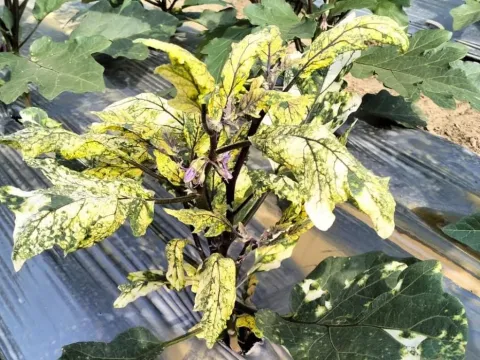
The key symptom is the appearance of a characteristic mosaic pattern on the leaves. Alternating light green and dark green spots create a specific pattern, which may be accompanied by vein clearing.
Frequent symptoms include leaf deformation, curling, crinkling, or shoestring-like shapes. The leaves become more fragile and smaller compared to healthy specimens.
Infected plants are noticeably stunted, internodes shorten, and excessive branching occurs, giving the bush a "witches' broom" or bushy appearance depending on the viral strain.
Fruits may show signs of chlorosis, necrotic spots, or ring-like patterns. The flesh of the fruit can develop an uneven structure, which negatively affects its taste and storage life.
- Yellowing of leaf margins.
- Reduced flowering intensity.
- Flower abortion and fruit drop.
- General chlorosis of the vegetative mass.
There are no effective chemical treatments for already infected plants, so control strategies are based entirely on preventive measures to limit the spread of the pathogen.
Primary importance is given to using high-quality, certified seed material that has undergone thermal or chemical treatment to disinfect the seed coat from viral particles.
Strict phytosanitary control in greenhouses is essential: regular weed management around the area and the destruction of insect vectors (beetles, aphids) using contact-systemic insecticides.
Adherence to work hygiene is mandatory: disinfection of garden tools with sodium hypochlorite solutions or specialized alcohol-based compounds after working with each individual plant.
Upon detection of infection foci, immediate removal and destruction of diseased plants along with the surrounding root ball are recommended. In large-scale operations, crop rotation with non-host plants should be implemented.