
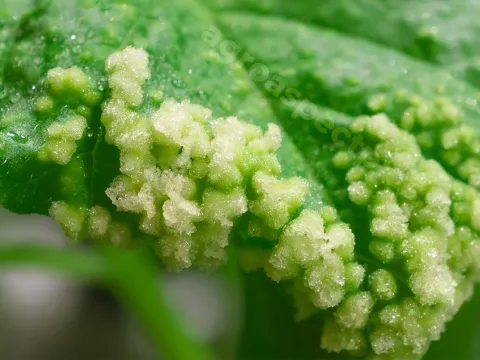
Edema
Edema
Edema is not an infectious disease caused by fungi, viruses, or bacteria. It is a physiological disorder that occurs due to an imbalance in the plant's water uptake and transpiration.
What the section contains
Edema
The condition develops when roots absorb water faster than the leaves can release it through the stomata. This causes cells to become engorged with water, eventually rupturing or distorting the tissue.
Essentially, edema is an abnormal accumulation of sap in the plant tissues, leading to visible bumps or blisters. It is most commonly observed in greenhouse crops and ornamental houseplants.
To correctly diagnose edema, one must rule out fungal pathogens like powdery mildew or rust. Edema is strictly linked to environmental factors such as watering frequency, light levels, and ambient temperature.
Because there is no biological pathogen involved (it is a non-infectious physiological state), edema does not spread from one plant to another.
Edema affects a wide range of plants, especially those with succulent leaves or those undergoing rapid growth in indoor environments.
Seedlings of solanaceous crops like tomatoes and peppers are highly susceptible, along with common houseplants such as geraniums, fuchsias, ficus, and various cacti.
The damaged tissue cannot perform photosynthesis efficiently, which slows down the plant's overall development. In severe cases, the affected leaves turn yellow and drop off.
The disruption of the epidermis leaves the plant vulnerable to opportunistic secondary infections, as fungi often colonize the necrotic areas of the leaves.
For growers and nurseries, edema results in a loss of aesthetic value, leading to significant economic losses in the ornamental plant industry.
The symptoms of edema are most prevalent during periods of high humidity and low light, typical of winter and early spring months.
Cloudy weather significantly decreases the rate of transpiration. If watering is not adjusted accordingly during these times, the risk of edema becomes extremely high.
Sharp temperature fluctuations between day and night also affect root activity, often triggering excessive water absorption that the foliage cannot manage.
In greenhouses, edema can occur at any time of year if proper ventilation is lacking, creating a stagnant, humid microclimate around the plants.
Young seedlings are particularly vulnerable during the adaptation period after transplanting, when the root system has not yet balanced its water uptake capacity.
The primary sign of edema is the formation of small bumps, blisters, or swellings on the underside of leaves, which eventually turn brown or cork-like.
These lesions often look like small warts. Depending on how long the tissue has been affected, the spots may feel firm or soft to the touch.
Over time, these areas may coalesce, leading to leaf deformation, yellowing, and premature senescence. In some cases, leaves may curl or twist significantly.
- Emergence of light or green-colored swellings.
- Change of affected areas to a brown or tan color.
- Distortion and curling of the leaf blade.
- Premature leaf drop in affected areas.
Edema develops gradually, so regular plant inspection is essential for catching the problem early and making the necessary adjustments to cultural practices.
The most important control measure is optimizing the watering schedule. Always allow the top layer of soil to dry out between waterings to ensure roots receive adequate aeration.
Improving light exposure increases transpiration rates, which helps the plant expel excess water more effectively through the stomata.
Ensuring constant air circulation is vital; proper ventilation prevents humidity buildup around the foliage and promotes faster drying of the growing medium.
It is recommended to use loose, well-draining potting mixes with additives like perlite or vermiculite to improve the structural health of the soil and prevent waterlogging.
Balanced fertilization, particularly with potassium, can strengthen cell walls and increase the overall tolerance of the plant to physiological stressors.