
Cereal Helminthosporiosis
Cochliobolus sativa
The causative agent of the disease is the fungus Cochliobolus sativus (anamorph Bipolaris sorokiniana), which belongs to the Ascomycota division. This pathogen is a major threat to barley, wheat, rye, and oats worldwide.
What the section contains
Cereal Helminthosporiosis
The pathogen survives in the soil, on crop residues, and within seeds as mycelium or conidia. It exhibits remarkable longevity, capable of persisting in the soil for several years even in the absence of a host plant.
Biologically, it is a facultative parasite, meaning it can survive both by attacking living plant tissues and by saprotrophic feeding on decaying organic matter. This flexibility makes it a persistent agricultural challenge.
Propagation occurs via conidia, which are disseminated by wind, rain splashes, and insects. During the growing season, multiple infection cycles can occur, leading to rapid spread if environmental conditions are favorable.
In laboratory diagnostics, the fungus is identified by culturing on agar media, where it produces dense, dark olive-black colonies with characteristic conidial structures.
The disease affects all plant organs throughout the growth cycle. It is known for causing seedling blight, common root rot, leaf spot, and black point disease in seeds.
Root rot is particularly devastating, as it damages the plant's ability to uptake water and nutrients, resulting in stunted growth, premature wilting, and reduced tillering.
Leaf spots caused by Cochliobolus sativus reduce the photosynthetic area of the leaves, directly impacting grain filling and overall biomass accumulation. Severe infection leads to premature leaf senescence.
Infection of the ear can lead to "black point," which lowers the seed's vigor and germinability. This compromises the quality of the harvest and the potential of the next season's crop.
The overall yield loss can be substantial, with severe outbreaks causing economic losses ranging from 20% to 50% in cereal production under conducive climatic conditions.
Primary infection occurs in early spring, as conidia germinate and infect emerging seedlings. High soil moisture and moderate temperatures are the key triggers for this initial phase.
During the summer, the disease spreads through the canopy. The fungus thrives at temperatures between 22 and 28 degrees Celsius, with high humidity accelerating its development.
Rainfall is a critical factor for the secondary spread of the pathogen, as raindrops splash spores from lower infected leaves to the upper foliage and the developing ears.
Even in dry conditions, the fungus remains active in the soil as a root parasite, exploiting the host plant's weakened state to continue its colonization of the root system.
As the season nears its end, the pathogen colonizes the stubble and post-harvest residue, preparing for the dormant period through the formation of robust survival structures.
Early symptoms include brown lesions on the coleoptile and primary roots of seedlings, which can lead to pre-emergence or post-emergence death of the young plants.
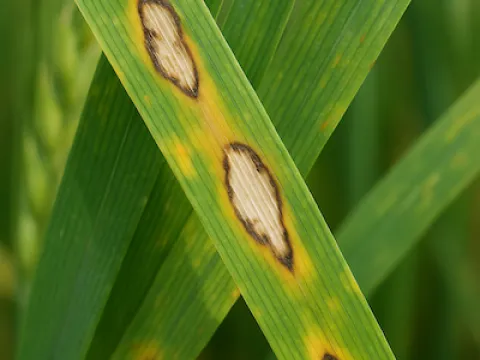
On leaves, the symptoms appear as small, dark brown or black spots that expand and eventually merge, creating large necrotic areas often surrounded by a chlorotic halo.
The ears may show discolored florets or dark brown patches on the glumes. The most definitive sign at harvest is the dark, blackish discoloration of the embryo end of the grain.
High humidity often induces the appearance of a dark, velvety mold on the surface of infected plant parts, which is the mass of fungal spores.
- Root and crown rot resulting in basal stem browning
- Oval-shaped necrotic spots on leaves
- "Black point" discoloration of the grain embryo
- General stunting and reduced plant vigor
The primary defense strategy is the use of systemic fungicidal seed treatments. This is essential for controlling seed-borne inoculum and protecting seedlings during the most vulnerable early growth stages.
Crop rotation is a vital cultural practice. Rotating cereals with non-host crops like legumes or oilseeds helps decrease the population density of the pathogen in the soil over time.
Effective management of crop residues through tillage encourages the decomposition of infected straw, thereby reducing the availability of the pathogen for future seasons.
Balanced fertilization, especially phosphorus and potassium, improves overall plant health, making crops more resilient to fungal attacks throughout the growing season.
In fields with high disease pressure, foliar fungicide applications during the stem elongation or flowering stages can effectively suppress the progression of the disease on leaves and heads.