
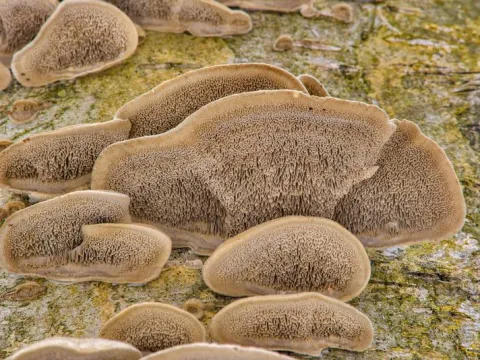
Cerrena unicolor
Cerrena unicolor
Cerrena unicolor is a species of fungus in the family Polyporaceae. It is classified as a white-rot wood-decaying fungus that primarily attacks broad-leaved trees.
What the section contains
Cerrena unicolor
The fruiting bodies are typically pileate, growing in dense overlapping clusters, with a characteristic hairy upper surface that is greyish-brown to dark brown.
A distinctive feature of this species is the pore surface, which transforms from tubular to labyrinthine or tooth-like (hydnoid) as the fungus matures.
It acts as a facultative parasite or saprotroph, efficiently breaking down both lignin and cellulose in the host's woody tissue through an enzymatic process.
The fungus is widely distributed in temperate zones and is commonly found on dead logs, standing dead trees, and living trees with compromised bark integrity.
The fungus causes white corrosion rot, which significantly degrades the structural integrity of the host's wood, turning it into a soft, fibrous mass.
Economic damage is substantial, as the infection significantly reduces the timber quality and the structural stability of landscape and forest trees.
Hosts include species such as birch, beech, maple, and apple, particularly those stressed by environmental factors, drought, or mechanical damage.
As the rot progresses, the internal trunk area becomes hollowed out, which can lead to tree failure and wind-throw, creating safety hazards in public areas.
The physiological stress caused by the infection leads to canopy dieback, reduced nutrient flow, and a general decline in the tree's overall vitality.
Sporulation and mycelial growth are most active during the humid periods of spring and autumn, with temperatures between 15°C and 25°C.
Fruiting bodies are perennial or can survive the winter, allowing for early-season spore dispersal when environmental conditions become suitable again.
Rainfall is the primary driver for infection, as high moisture levels facilitate the germination of spores that have landed on tree wounds or cracks.
The spread of the pathogen is facilitated by wind, which carries spores over long distances, often infecting trees within the same stand rapidly.
Environmental fluctuations do not typically kill the fungus, but high summer heat may temporarily slow its visible growth until moisture levels return.
The most reliable sign of infestation is the emergence of hard, hairy brackets on the bark, often concentrated near injuries or branch stubs.
Internally, the infected wood shows white, bleaching patches with dark brown or black demarcation lines, characteristic of white rot development.
- Presence of hairy, imbricate fruiting bodies.
- Wood fiber separation and softening of the heartwood.
- Localized bark necrosis and resin flow near the infection site.
Leaves on branches supplied by infected tissue may show signs of yellowing or premature wilting due to the impairment of water conduction.
The texture of the wood under the bark becomes spongy to the touch, and the typical "tooth-like" surface of the fungus appears as it matures.
Management focuses on sanitation, which involves the removal and proper disposal of heavily infected trees and hazardous deadwood to reduce spore load.
Preventative care includes the protection of bark from mechanical injury during landscaping or logging operations, as these are the primary entry points.
In cases of minor wounds, applying pruning sealants or copper-based fungicides can help prevent the fungal colonization of fresh wood tissue.
Maintaining high tree vigor through proper irrigation and fertilization helps the tree develop its own natural defenses against wood-decay pathogens.
Regular monitoring of forest stands or park trees is essential to identify early-stage infections before the fungus compromises the structural stability of the tree.