
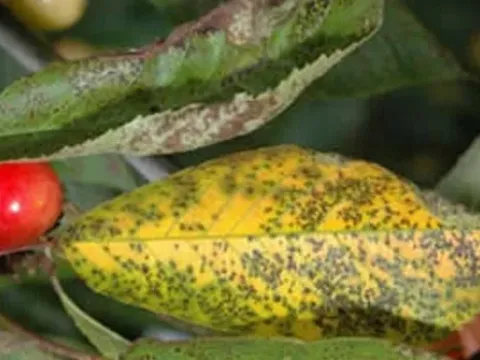
Blumeriella jaapii (cherry leaf spot)
Blumeriella jaapii
The causal agent of cherry leaf spot is the ascomycete fungus Blumeriella jaapii (syn. Coccomyces hiemalis), which belongs to the order Helotiales.
What the section contains
Blumeriella jaapii (cherry leaf spot)
The fungus overwinters in fallen leaves as apothecia, which discharge ascospores in early spring to initiate primary infections on emerging leaves.
Secondary spread is facilitated by conidia produced in acervuli, which are splashed by rain onto healthy foliage during the growing season.
The development of the pathogen is highly dependent on environmental conditions, specifically requiring moisture for spore germination and infection.
The life cycle involves multiple infection cycles per season, allowing the fungus to propagate rapidly in humid and warm weather conditions.
The disease primarily affects Prunus species, including sour cherry, sweet cherry, and occasionally plums and apricots.
Infection significantly reduces the tree's photosynthetic capacity, leading to premature defoliation, often occurring as early as mid-summer.
Severe defoliation weakens the tree, preventing the accumulation of nutrient reserves required for winter survival and next season's growth.
Trees affected by the disease exhibit increased sensitivity to winter injury, often resulting in limb dieback or complete tree death.
Fruit development is severely hindered, resulting in small, tasteless fruits that fail to ripen properly, causing substantial economic loss.
The primary infection period typically begins in late spring, following petal fall, when weather conditions become favorable for spore dispersal.
The peak activity occurs during the summer months, with epidemics often correlated with rainy periods and prolonged leaf wetness.
Spore production continues throughout the growing season, provided there is enough moisture to support the maturation of acervuli on the leaves.
As the season progresses, the cumulative effect of repeated infection cycles can lead to total leaf loss before the onset of autumn.
The pathogen completes its annual cycle by entering a dormant phase in necrotic leaf tissue on the orchard floor during the winter months.
The initial symptoms appear as small, circular purple to reddish-brown spots on the upper leaf surface, which may enlarge over time.
On the underside of the leaves, white or pinkish masses of conidia become visible in the center of the lesions during humid conditions.
Heavily infected leaves turn yellow or brown and drop prematurely, creating a characteristic sparse canopy effect in the orchard.
Lesions can also manifest on fruit pedicels and petioles, leading to fruit shriveling or premature fruit drop due to impaired nutrient transport.
Under favorable conditions, lesions may coalesce, resulting in large necrotic patches and subsequent disintegration of the leaf tissue.
Sanitation is a critical management practice; removing or destroying fallen leaves significantly reduces the primary inoculum source for the next year.
Pruning and managing canopy density improve air circulation, allowing foliage to dry faster and reducing the duration of leaf wetness required for infection.
Chemical control focuses on applying fungicides during susceptible growth stages, particularly from petal fall through harvest.
Use of protective copper-based sprays and modern systemic fungicides, such as triazoles or strobilurins, is recommended for effective disease suppression.
Implementing an integrated pest management program, including rotation of fungicide classes, is essential to prevent the development of resistant pathogen strains.