
Beet yellows
Beet yellows
The causative agent is the Beet yellows virus (BYV), a member of the Closteroviridae family. It consists of flexuous filamentous particles containing single-stranded RNA.
What the section contains
Beet yellows
The virus is exclusively transmitted by aphids, most notably the green peach aphid (Myzus persicae) and the black bean aphid (Aphis fabae), in a semi-persistent manner.
It does not spread mechanically or through seeds. Instead, it relies on overwintering in infected beet roots, particularly in seed crops or sugar beet regrowth left in the field after harvest.
Once introduced into the plant, the virus colonizes the phloem tissues. By obstructing the transport of photosynthates, it creates a systemic infection that affects the entire physiology of the host.
The spread of the disease is dependent on the migration of winged aphids. These vectors pick up the virus from infected hosts and transmit it to healthy plants during feeding.
The primary host is Beta vulgaris, including sugar beet, red beet, and fodder beet. A wide range of weed species, particularly from the Amaranthaceae family, acts as reservoirs.
Infection results in severe yield losses, often ranging from 30% to 50% depending on the timing of the infection. Early season outbreaks have the most devastating impact on root development.
The accumulation of sugar in the roots is significantly inhibited, which lowers the quality of the harvested crop and reduces the overall sugar extraction efficiency in factories.
Seed crops infected with BYV produce lower quality seeds with reduced germination rates. This creates long-term productivity issues for subsequent planting cycles.
Stressed plants become more susceptible to secondary fungal pathogens such as Cercospora beticola, which further damages the photosynthetic capacity of the foliage.
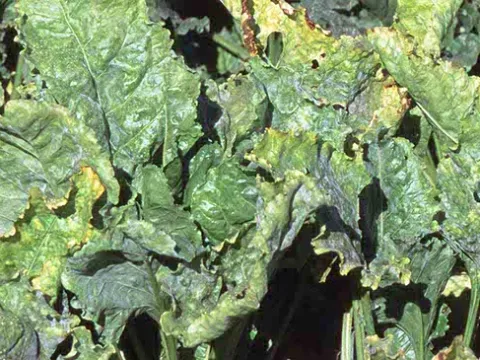
The first symptoms appear as chlorotic yellowing on the middle-aged leaves. This yellowing typically occurs between the veins, while the primary veins remain green for an extended period.
As the disease progresses, affected leaves become brittle, thick, and leathery. They often curl downwards at the edges and may develop necrosis under severe environmental stress.
Infected plants show stunted growth and a flattened, rosette-like appearance. The petioles become shorter, and the plant loses its healthy, upright architecture.
The disease usually occurs in circular or irregular patches within the field. These patches grow larger as aphids move from plant to plant during the growing season.
The visual impact is striking: a distinct yellowing of the crop canopy that contrasts with the deep green of healthy, non-infected neighboring plants.
Spatial isolation is the most effective cultural strategy. New beet crops should be planted far away from second-year seed crops, which act as the primary inoculum source.
Effective weed control is essential to eliminate alternative host plants and to reduce the population pressure of aphid vectors within and around the field edges.
Monitoring for aphid populations is critical. If threshold levels are reached, systemic insecticides should be applied to prevent the spread of the virus by killing the vectors.
Selecting and planting genetically resistant or tolerant sugar beet varieties is the most sustainable approach to minimizing the impact of the disease in high-risk areas.
Post-harvest hygiene, such as thorough plowing to destroy all volunteer beet plants and crop residues, is necessary to break the lifecycle of the virus and prevent overwintering.