
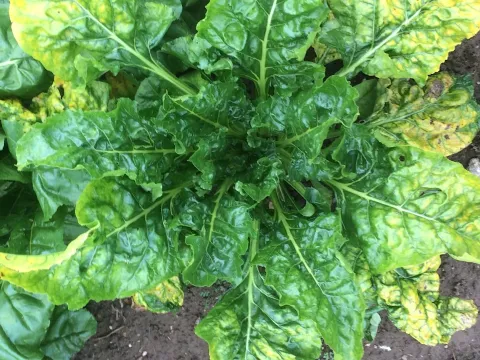
Beet yellows
Beet yellow
Beet yellows is caused by the Beet yellows virus (BYV), a member of the Closterovirus genus. The virus is characterized by long, flexuous filamentous particles and is strictly phloem-limited within the host plant, disrupting transport functions.
What the section contains
Beet yellows
The virus is not mechanically transmissible in the field through sap or debris. Instead, it relies on specific insect vectors, primarily the green peach aphid (Myzus persicae) and the black bean aphid (Aphis fabae), for transmission.
The transmission is semi-persistent, meaning that aphids can acquire the virus after a short feeding period and immediately transmit it to healthy hosts. The virus does not replicate within the aphid vector, which limits the transmission duration.
BYV is a global problem in sugar beet cultivation. It persists in various overwintering hosts, including wild beets, spinach, and several weed species in the Amaranthaceae family, which serve as reservoirs for the virus.
Understanding the epidemiology of BYV is crucial for successful management, as the virus's spread is entirely dependent on the migration patterns and population dynamics of the aphid vectors throughout the growing season.
The primary economic host is sugar beet (Beta vulgaris), though the virus can infect table beet, mangel, and swiss chard. Systemic infection leads to a severe decline in photosynthetic efficiency across the entire plant.
The virus significantly reduces both the total root yield and the sucrose concentration in sugar beets. This results in direct economic losses for the sugar processing industry due to reduced sugar extractability.
Early-season infections are particularly devastating, often causing yield losses of up to 50%. The reduction in leaf surface area and physiological stress makes the plants less capable of recovering from further environmental or pest pressure.
Secondary infections by fungi, such as Ramularia or Cercospora, are common on beet yellows-infected plants because the weakened physiological state leaves the plants highly susceptible to opportunistic pathogens.
The impact is widespread, as even low incidence levels in a field can lead to significant reductions in net profit per hectare. The cumulative effect of stunted growth and poor root quality makes this one of the most critical viral diseases in agriculture.
Initial symptoms include the yellowing of older, lower leaves. As the infection progresses, the yellowing becomes more intense, often starting at the leaf tips and margins before spreading across the entire lamina.
Infected leaves become thickened, leathery, and brittle. A distinct feature is the downward curling of leaf margins, giving the plant a stunted and sickly appearance compared to healthy, vigorous plants in the same field.
In advanced stages, necrotic spots, often dark brown or black, develop on the yellowed leaf tissue. This tissue death is a result of extreme metabolic dysfunction and the accumulation of high sugar concentrations that cannot be transported to the root.
Symptoms often appear in patches within the field, reflecting the initial colonization by aphids. Unlike nutrient deficiency, which typically affects the whole field uniformly, BYV creates localized, expanding zones of infection.
Confirmation of the disease usually requires diagnostic tools such as ELISA (Enzyme-Linked Immunosorbent Assay) or PCR, as visual symptoms can sometimes overlap with nitrogen deficiency or magnesium stress.
The primary control strategy involves managing aphid populations. The use of systemic insecticides, particularly seed treatments or foliar sprays, is essential to minimize virus transmission during the critical early growth stages.
Maintaining spatial isolation between current crops and sources of infection, such as old beet dumps, seed beet fields, or overwintered root piles, is a fundamental and highly effective preventative measure.
Effective weed management, specifically targeting alternate hosts like wild Chenopodium and other weed species, helps reduce the local inoculum levels. Cleaning field margins and ditches is a mandatory practice.
Breeding and utilizing tolerant cultivars is a major focus for long-term control. While complete resistance is rarely found, varieties that can withstand higher virus titers without massive yield loss are available.
- Regular monitoring of aphid flights using yellow sticky traps.
- Planting at optimal dates to escape peak aphid migration.
- Post-harvest deep tillage to destroy volunteer beets and roots.
- Implementing integrated pest management (IPM) to preserve natural aphid predators.