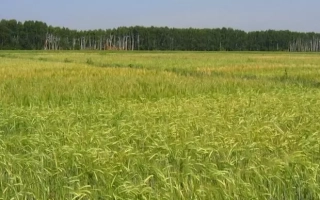
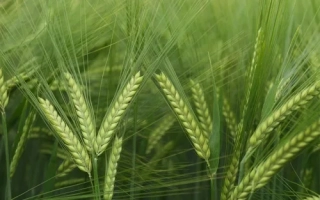
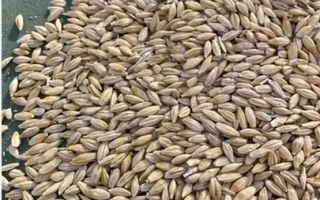
The Sasha spring barley variety belongs to the medicum group and the steppe ecotype. It is intermediate-early maturing with a vegetative period of 74-87 days, ripening slightly later than standard varieties such as Omsky 91 and Biom. The plant is intermediate-height, about 70-74 cm tall, with a semi-erect bush and a sturdy, medium-thickness straw. The ear is pyramidal-cylindrical in shape, of medium density, with long smooth awns and strong anthocyanin coloring at the tips. The grain is large, yellow, thin-husked, with a 1000-grain mass ranging from 45 to 56 g, and good flowability during sowing. The variety is characterized by high drought resistance, exceeding standard varieties by 0.5-0.8 points in this indicator. In terms of resistance to lodging, it is slightly inferior to some varieties, but overall possesses sturdy straw and a medium-thickness stem. The variety is moderately resistant to loose smut and covered smut, but susceptible to powdery smut, root rot, and helminthosporium. The anthocyanin coloring of the flag leaf auricles and the waxy coating on leaf sheaths are very pronounced, which is a characteristic feature of the variety. Sasha is intended for grain-forage production and recommended for cultivation in the Western Siberia and Ural regions, including the Omsk region. The variety yields high and stable harvests, averaging 34 c/ha, with maximum indicators reaching up to 76 c/ha. The variety responds well to improved cultivation conditions, which allows for an increase in protein, starch, and crude fat content in the grain. Protein content varies from 10.7 to 17.5%, fat is about 2.25-2.43%, and starch is about 56.2%. Thanks to these characteristics, the Sasha variety is a reliable choice for forage use.