One of the most widespread autumn varieties of folk selection in the Middle Strip of Russia. Originating from Baltic countries, it is a favorite variety in the Middle Strip of Russia. Included in the State Register of the Northern, Northwestern, Central, Volga-Vyatka, Central Chernozem, and Middle Volga regions.
Trees are vigorous, with a broad, bowl-shaped crown and drooping branch tips. Branches are strong. Fruit set type is mixed; some fruits are located on short, ringed buds on three- to four-year-old wood, while others are on the tips of long two-year-old shoots.
Shoots are thick, brown, and heavily hairy. One-year-old plants grow vigorously in the nursery. Bark on shoots in the nursery is smooth, slightly shiny, heavily hairy, and chestnut-brown. Pods are distinctly visible, round or elongated, light yellow. Buds are wide, very convex, gray. Leaves are round or broad, with irregular, coarse-toothed margins, not curled, deeply lobed along the central vein, twisted, wrinkled, heavily (woolly) hairy, with a twisted, shingle-like apex. Leaves are densely arranged on shoots, especially in their upper part, and are elevated upward, i.e., they diverge from the stem at an angle less than straight. On one-year-old plants in the nursery, leaves are large, dull, heavily hairy, coarse-wrinkled, with large-toothed margins, on short, thick, reddish petioles. They are densely arranged, forming a “hat” at the shoot tip.
Flowers are large, saucer-shaped or cup-shaped, buds light pink, petals white, round, concave, overlapping, stigma thick with fused stigmatic column, stigmas slightly higher or level with anthers.
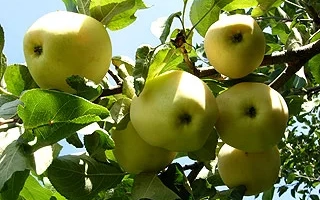
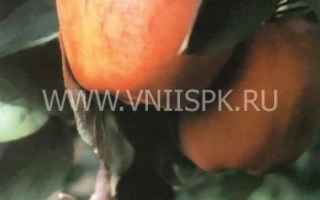
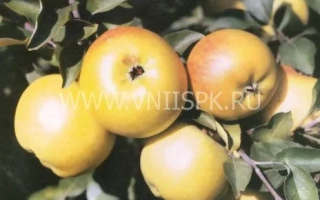
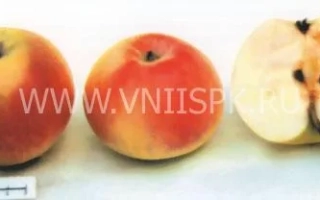
Fruits (Fig.) are above-average or large, often unequal-sided, truncated-conical or rounded-conical in shape, with well-defined ribs at the base. Fruit surface is smooth. Skin is thin, smooth, with a waxy coating. Primary color is greenish-yellow when picked and yellow at full ripeness. Cover color is bright orange-red stripes on a mottled background over most of the fruit surface. At ripening, cover color acquires a brownish tint. There are known red-fruited mutants of Autumn Striped with solid dark-red fruit color. Aside from fruit color, these clones are practically identical to the original variety. Under-skin spots are small, light, clearly visible. Fruit stalks are long or medium-length. Calyx is narrow, ribbed. Receptacle is large, irregularly shaped, closed or half-open. Funnel is narrow and very small, with delicate rusting. Seed cavity is close to the base of the fruit (to the fruit stalk). Seed chambers are large, half-open. Seeds are large, elongated, brown.
Flesh is pale yellowish, sometimes pinkish under the skin, loose, fairly juicy, with a balanced tart-sweet flavor. Chemical composition of fruits: sugar total — 10.1%, titratable acids — 0.57%, ascorbic acid — 8.3 mg/100g, P-active substances 280 mg/100g, pectin substances — 12.0%.
Harvest maturity of fruits in Oryol Oblast occurs at the beginning of September.
Fruits can be stored in a refrigerator until early December. Used fresh and are good raw material for making juices.
Fruit-bearing period begins relatively late — at 8–9 years. Mature trees yield high yields. At the Oryol Fruit and Berry Experimental Station (now VNIISPK), full-grown trees produced yields of 150–180 centners per hectare. In some years, yields were even higher. There are records indicating that at the Oryol Support Station (now the “Botany” department of VNIISPK) in 1937, the average yield of 20-year-old trees reached 276 kilograms, and the maximum yield was 429 kilograms per tree. Young trees of Autumn Striped bear fruit annually, while mature trees (after 18–20 years) bear fruit intermittently.
The variety is above-average winter hardiness. 25–30-year-old trees during the winter of 1955–1956 had slight frost damage (1.7 points). This variety is most susceptible to frost damage on flower buds and three- to four-year-old wood. Flower buds are very cold-resistant and even after severe winter 1955–1956, showed no significant damage. In terms of winter hardiness, Autumn Striped is inferior to Striped Quince, Moscow Pear, Anise, and Antonovka Ordinaire, but superior to Welles and Pippin Shafra. As a variety developed in a more humid region, Autumn Striped has weak drought resistance. This is evidenced by premature leaf drop in years with dry second halves of summer.
Trees are relatively long-lived. Resistance to fruit and leaf scab is medium or above-average.
Advantages of the variety: good yield, high fruit quality, fruit marketability.
Disadvantages of the variety: relatively late fruiting, intermittent (though not pronounced) fruiting of trees, large tree size, relatively weak drought resistance.