This variety was developed at the Rossohskaya Zonal Experimental Station for Horticulture from a cross between the varieties Prima and Effektivna. Authors: A.Y. Voronchikhina, A.I. Sychov. In 2004, the variety was included in the State Register of Selection Achievements approved for use in the Central Chernozem region.
The tree is medium to tall, reaching up to 4-5 meters in maturity, with a rounded, spreading crown of moderate density and good leafing. The bark on the trunk is black-gray, gray on younger trees, medium or strongly rough, peeling, with weak or moderate longitudinal cracking and minimal or absent spiral cracking. Buds are convex, medium or long, elongated-oval, arranged with moderate density. Shoots are straight, with long internodes, initially greenish-brown, then gray-brown with a silvery tint and longitudinal cracking, bare, with protruding, oval, small, brownish-gray buds. Vegetative buds are large, 4-5 mm, more cone-shaped than egg-shaped, with a pointed apex, protruding. Flowering buds are larger, 5-6 mm, elongated-egg-shaped, with a more rounded apex, set back. Leaf blade is elongated-oval or rarely oval, with a gradually tapering apex and a curved base, 8-10 cm long, 4-6 cm wide on one-year shoots, green on top, nearly smooth, bare, slightly or moderately concave along the central vein, matte, pale gray-green underneath with a cream-pink central vein and sparse woolly hairs along lateral veins; dentation is double-toothed, medium in depth, blade texture leathery. Petiole is relatively short, 15-20 mm, medium thickness, slightly hairy on top, bare on the underside, with weak brownish-purple anthocyanic coloration. Stipules are narrow-lanceolate, 5-10 mm long, deeply toothed, persisting for a long time. Inflorescences usually bear 3 flowers, medium-sized, white.
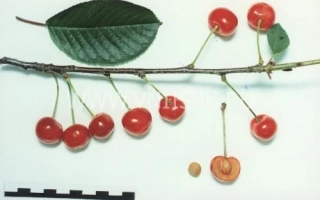
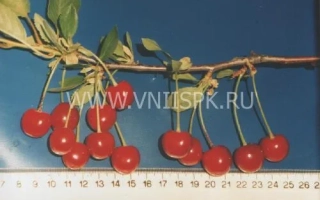
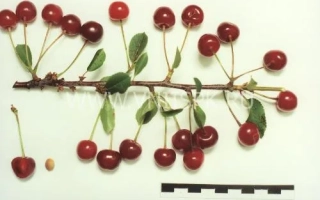
Fruits average 5.3 g in weight, 18 mm high, 21 mm wide, 20 mm thick, flat-round to round, heart-shaped, medium or fairly strongly flattened laterally, with a wide depression, rounded apex, slightly depressed base of the stigma. Skin color is dark cherry-red, nearly black, with intensity of color ranking among the best. Flesh is dark cherry-red, nearly black, with a network of fine veins near the skin, fairly firm, juice dark red. Flavor is pleasantly tart-sweet, with a tasting score of 4.0 points. Biochemical composition of fruits: 15.4-20.6% soluble solids; 10.6-15.1% sugars; 1.5-1.6% titratable acids; 0.25-0.36% tannins and coloring substances. Fruit stalk is short, 25-35 mm long and 1-1.3 mm thick, loosely attached to the pit, in fully ripe fruits detachment is nearly dry, in underripe fruits a small piece of skin with flesh often separates together with the stalk. Pit averages 0.35 g, which is 6.6% of fruit weight, oval, with a rounded apex and base shaped like a straight line, often slightly angled; fresh pit color is light brown with a pinkish hue, poorly separates from flesh. Technological qualities of fruits are good: compotes are rated 4.6 points for appearance and 4.5 points for taste on average.
Flowering occurs very early; the variety is self-fertile. Fruits ripen in early-to-medium season, in the southern part of the Central Chernozem region by the third decade of June. Trees grafted onto Antipka begin fruiting 3-4 years after planting in the orchard, with moderate rate of yield increase — average yield over the first 4 years of fruiting was 2.7 kg/tree, higher than the control variety Zhukovskaya (at this time, 1994, with an extremely unfavorable winter). During full fruiting, average yield was 15.2 kg/tree, and in the most favorable years, average yields reached 25-30 kg/tree.
Winter hardiness of trees in the southern part of the Central Chernozem region is good, average degree of freezing damage in the extremely unfavorable winter of 1993-1994 amounted to 1.3 points (in control variety Zhukovskaya — 1.7 points). Flower bud resistance is high, maximum percentage of bud death over the last ten years of study did not exceed 14.0%. Resistance to coccomycosis is below average, comparable to varieties Zhukovskaya, Kentskaya, and Griot Ostgaimskiy. Moniliosis affects weakly, maximum degree of infection did not exceed 1.0 point.
Advantages of the variety: large, intensely colored fruits.
Disadvantages of the variety: not always regular yield, wet fruit detachment.