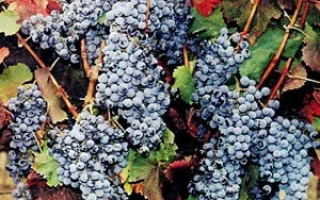
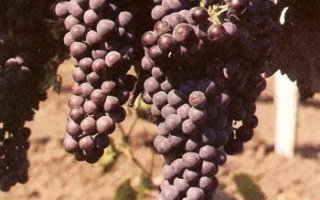
Cobert 5BB is an old and widely used grapevine rootstock developed at the end of the 19th century by crossing wild American species Vitis berlandieri and Vitis riparia. Its creators are the French agronomist Évrard Rességuie, the Hungarian viticulturist Sigmund Teleki, and the Austrian inspector Franz Cobert. The rootstock is characterized by vigorous vines with long, straight, and spreading canes up to 4-5 meters in length and a strong root system penetrating the soil to a depth of up to 7 meters. The leaves are large, round or slightly elongated, dark green, leathery, with a distinctive petiole notch in the shape of the Latin letter V. The flowers are functionally female, clusters are small and loose, berries are small, round, black with a bluish tint. Cobert 5BB has high cold hardiness of buds and roots, tolerating frosts down to -30 °C for buds and -9 °C for the root system. The rootstock is resistant to phylloxera and fungal diseases, making it a reliable choice for southern regions. It adapts well to light, deep, and permeable soils, especially sandy ones, as well as to calcareous soils with carbonate content up to 35%. Drought resistance is high, but salt tolerance is low, and adaptation to waterlogged soils is moderate. Using Cobert 5BB as a rootstock promotes increased cane growth of the grafted variety and increases average cluster and berry mass, positively affecting yield. However, this may lead to some reduction in berry quality and delayed ripening. The vine matures approximately 80%, and shoot and sucker formation is moderate. Cuttings root satisfactorily, and for increased rooting success, root pruning is applied. The rootstock is not recommended for varieties prone to flower drop during flowering, and for very fertile soils, where vigorous growth may worsen berry coloring and vine maturation.