Late-ripening variety, developed at the All-Russian Research Institute of Fruit Crop Selection from crossing the varieties Rotte Schpeltze and Jonker van Tets. Authors: L.V. Bayanova, O.D. Golayeva, M.A. Makarkina. Since 2007, included in the State Register of Breeding Achievements approved for use in the Central Chernozem region.
Bush is vigorous, moderately spreading, dense. Growing shoots are thick, straight, green with slight anthocyanin 'tanning', slightly hairy.
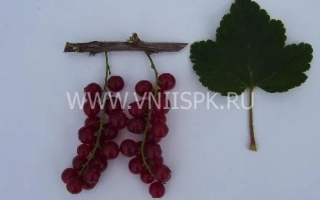
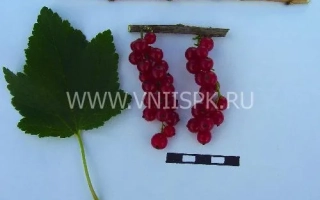
Leaf three- to five-lobed, medium-sized, dark green, leathery, matte, hairy underneath. Leaf blade is straight. Lobes are blunt, angle between central veins of side lobes is acute. Base of leaf has shallow notch. Teeth are short and sharp. Petiole is thick, colored at base.
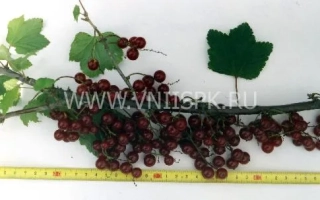
Flowers are small, cup-shaped, calyx and receptacle green. Sepals are green, no anthocyanin coloration, short, broad, not touching, curled downward. Inflorescences are medium length (8-11.0 cm with petiole), dense — up to 20 berries. Inflorescence axis is thick, straight, hairy. Petiole of inflorescence is long.
Berries are medium to large (0.6-0.9 g), one-dimensional, round-oval, light-red, sweet-sour taste. Calyx is half-open. Chemical composition: dry matter — 12.0%, total sugars — 7.9%, titratable acidity — 2.5%, ascorbic acid — 47.5%, P-active substances — 426.0 mg/100 g, pectin substances — 7.6%.
Variety is cold-resistant, high-yielding, average multi-year yield is 20.2 t/ha (2.9 kg/plant at planting scheme 0.5 x 2.8 m), highly self-fertile, resistant to powdery mildew, moderately affected by septoria.
Advantages of the variety: high cold resistance, yield, and self-fertility, resistance to powdery mildew.
Disadvantages of the variety: insufficiently high berry flavor quality, observed frost damage to plants after sharp temperature drop following thaw, leaf spot diseases.