


SKU #4653
·
343 views
Currant Non-Viewable
Currant
Prices in stores
from1.09 €per seedling
pack from 0.18 € per pack
17 offers from 17 stores
Type of Variety
Redcurrant
Your mark
0 votes
0% positive ratings
Store offers · 17 from 17 stores
17 offers in 17 stores — from 1.09 € per seedling.
Available at: Agro-market · Чудеса Саду · fittonia-ru · irkutsk-legendi-rastenii-ru · LeafLand · moscow-garden24-ru · plodovyimir-ru · Plodsad · Posadka · sad-vl-ru · Sadovnikoff · scsadovod-ru · Плодопитомник Сад · tutifruti-sk · vladivostok-plodopitomnik-sad-ru · Ycadba
Prices are collected automatically from store websites and converted at the current exchange rate. Check the price and availability on the store website before ordering.
Description
Mid-season ripening variety, developed at the Institute of Berry Cultivation of the National Academy of Sciences of Belarus from crossing of varieties Vichnevaya X (Chudesnaya + Hollandskaya Krasnaya). Author A.G. Voluznev. Since 2006, included in the State Register of Selection Achievements approved for use in the Central Region of the Russian Federation.
Medium-height, slightly spreading bush with medium branching. Growing shoots are thick, straight, moderately colored with anthocyanin, hairless. Woody shoots are gray, with peeling epidermis. Buds of medium size, elongated, deviated from the shoots. Petiole scar is wide, wedge-shaped.
Leaf five-lobed, large, dark green, leathery, matte, medium-veined. Leaf blade is straight. Leaf margin is wavy. Central lobe is elongated, exceeds lateral lobes, with rounded apex. Lateral lobes are short, with small notches between them, angle between central lateral veins is acute. Basal lobes are weakly expressed. Base of leaf has a small notch of medium size. Teeth are blunt, short, curled. Petiole of medium length, reddish.
Flowers of medium size, deep bowl-shaped. Sepals are medium-sized, with red stripes, curved downward. Inflorescences of medium length, dense, arching downward. Axis is thin, green, petiole of medium length.
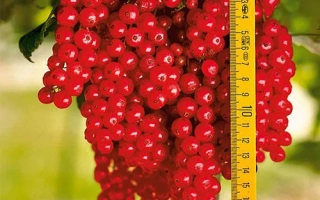
Berries medium-sized (0.6-0.8 g), single-lobed, round, bright red, medium seed count, sour-sweet taste, rating 4.8 points. Berries of universal use. Calyx is pentagonal, small, open, pedicel of medium length. Chemical composition: dry matter - 15.4%, total sugars - 6.0%, titratable acidity - 2.6%, ascorbic acid - 30.2 mg/100 g.
Winter-hardy variety, high-yielding (11.3 t/ha), characterized by good self-fertility, resistant to American powdery mildew.
Advantages of the variety: high yield, winter hardiness.
Disadvantages of the variety: susceptible to leaf spot diseases.
Video · 4 videos
Suggest a video →Crop & resistance
Crop
Disease resistance
Specifications
| Type of Variety | |
|---|---|
| Catalog | Catalog → Currant |
No reviews yet. Be the first to share your experience.
Alternatives
Currant saplings · similar varieties


See also
Often considered together with this variety



Recently viewed
Products you’ve viewed on this site
Reviews