


SKU #4659
·
223 views
Currant Orlovchanka
Currant
Type of Variety
Redcurrant
Your mark
0 votes
0% positive ratings
Store offers · 7 from 5 stores
7 offers in 5 stores — from 5.3 € per seedling.
Available at: Исида Парк · Королевский сад · Лучший Сад · Сады Семирамиды · Agromir
Prices are collected automatically from store websites and converted at the current exchange rate. Check the price and availability on the store website before ordering.
Description
Late-ripening variety, obtained at the All-Russian Research Institute of Fruit Crop Selection from crossing the varieties Rotte Schpitzlese and Jonker van Tets. Breeders: L.V. Bayanova, O.D. Golyaeva, M.A. Makarkina. Under state variety testing since 2002.
Medium-height, spreading, dense bush. Medium-thick, green, slightly hairy stems.
Three- to five-lobed leaves, medium size, dark green, matte, without hairs. Lobes are blunt, small indentations between central and lateral lobes. The angle formed by the central veins of lateral lobes is close to right angle. Basal lobes are poorly defined. Leaf base has a small notch. Teeth are short and blunt. Petiole of medium thickness, green, with weak anthocyanin "tan".
Small, cup-shaped flowers. Sepals are green, strongly twisted, do not touch. Inflorescences of medium length (8.0-10.0 cm), dense. Petiole of inflorescence is short, with anthocyanin coloration.
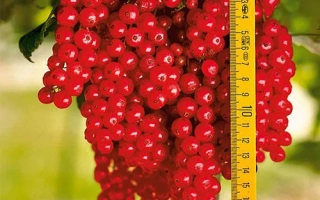
Berries of medium size (0.5-0.6 g), one-dimensional, round, red, sweet-sour, possessing high gelling properties. Chemical composition: dry matter — 12.4%, total sugars — 6.8%, titratable acidity — 2.3%, ascorbic acid — 55.3%, P-active substances — 380.0 mg/100 g, pectin substances — 11.9%.
Winter-hardy, high-yielding, average multi-year yield is 19.7 t/ha (2.8 kg/plant at planting scheme 0.5 x 2.8 m), not affected by powdery mildew, susceptible to anthracnose and septoria.
Advantages of the variety: high-yielding, high pectin content and quality of processed products (jelly), resistance to powdery mildew.
Disadvantages of the variety: insufficiently high flavor and commercial quality of berries.
Crop & resistance
Crop
Disease resistance
Specifications
| Type of Variety | |
|---|---|
| Catalog | Catalog → Currant |
No reviews yet. Be the first to share your experience.
Alternatives
Currant saplings · similar varieties


See also
Often considered together with this variety


Recently viewed
Products you’ve viewed on this site
Reviews