The variety was developed in Germany by L. Schpët. It was included in the State Register in 1947 for the North Caucasus and Lower Volga regions.
The tree is vigorous and long-lived. It forms a dense, broad-pyramidal crown with persistent (up to 12 years) lateral branches. The trunk is straight, smooth, with medium quantity of buds, medium size. The shoot is straight, internodes medium — 4 cm, brownish color with weak intensity, without hairs. The vegetative bud is conical, pointed, small, pressed. The leaf is elongated-oval, apex pointed, base shape tree-like. Leaf blade below average size, length medium — 7.3 cm, narrow — 3.8 cm, area 27.8 cm, light green, flat, texture loose, thin, upper surface matte, no hairs on upper surface, lower surface weak along central and lateral veins. Toothedness double-serrated, medium size. Petiole short — 8 mm, colored with anthocyanin. Stipules absent. Flower: two from one bud, corolla flat, large — 28 mm. Petals oval-shaped, medium size, length 13 mm, width 7 mm. Color of buds and petals white. Medium-fused. Apex rounded, margin wavy, corrugation medium. Stamens: small number — 18, filament length 7–11 mm, straight, pollen yellow. Pistil: length 13 mm, filament length 12 mm, straight, pollen yellow. Calyx bell-shaped, without hairs. Calyx lobes lanceolate, 7 mm long, 2 mm wide, without hairs, no toothed edge. Pedicel medium — 11 mm long, hairless.
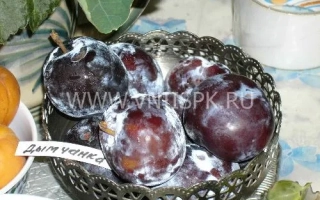
Fruit oval or broad-oval, equilateral, large, weight 45 g. Main color light yellow, covering red-purple, solid. Hairs absent. Numerous lenticels, color gray. Waxy coating dense. Stigmatic suture weakly expressed, does not crack. Skin thin, dense, easily removed, texture loose. Flesh color yellow-green, slightly darkens in air. Pulp cavity monochromatic with flesh. Flesh texture fibrous, dense, juicy. Pit: elongated-oval, medium size, length 22 mm, width 13 mm, thickness 8 mm, weight 1.5 g. Color dark brown. Apex rounded, base elongated. Suture continuous, open. Stigmatic suture narrow. Central rib well expressed. Side ribs absent. Ridge small, blunt. Surface pitted-bumpy.
Fruits are good for fresh consumption and some types of preservation. Unsuitable for dried fruit production and freezing. Fruit ratings: frozen fruit — 3.8 points, dried fruit — 3.9 points, compote — 4.2 points, juice with pulp — 3.8 points, marinade — 4.1 points. Fruits contain on fresh weight: dry matter — 15.7%, sugars — 9.9%, acids — 0.73%, sugar-acid index 13.56, pectin substances — 0.80%, polyphenols — 384 mg/100g, ascorbic acid — 6.5 mg/100g.
Flowering period medium — mid-April. Partially self-fertile. Ripening period very late — end of September. Time to enter fruiting 3–5 years. High and regular yield. Medium winter hardiness of wood and flower buds. Characterized by high regenerative capacity, therefore even buds of trees with strong frost damage recover well. Drought resistance satisfactory. On carbonate soils severely affected by chlorosis. Low maintenance requirements. Insufficient resistance to polyphagous mites and moniliosis.
Advantages of the variety: high yield, late fruit ripening.
Disadvantages: low preservation qualities of fruits, susceptibility to diseases.