


SKU #4221
·
980 views
Eurasia 21
Plum
User rating
0 votes0% positive reviews
No ratings yet — be the first.
Type of Sort
Home Drain
Store offers · 2 from 2 stores
Prices are updated on loadLoading offers…
Available at: AgronomVIP · Сад от А до Я
Aggregator catalog: prices are collected automatically from store websites, normalized by AI and converted at the current exchange rate. Before ordering, confirm the price and availability on the store's website. This block is not indexed by search engines — the data is loaded after the page opens.
About product

Complex interspecific hybrid obtained from spontaneous hybridization of the diploid variety Lakerescent, developed in the USA by Professor Olderman. Selected from seedlings of the hexaploid group from open pollination (6x=48). In forming the genotype of Eurasia 21, diploid species (2x=16) from eastern Asian, American plum, Simon plum, Chinese plum, almond, and domestic plum (6x=48) were involved.…
Type of Sort
Home Drain
Description
Complex interspecific hybrid obtained from spontaneous hybridization of the diploid variety Lakerescent, developed in the USA by Professor Olderman. Selected from seedlings of the hexaploid group from open pollination (6x=48). In forming the genotype of Eurasia 21, diploid species (2x=16) from eastern Asian, American plum, Simon plum, Chinese plum, almond, and domestic plum (6x=48) were involved. Originator — Voronezh State Agrarian University. Authors: A.N. Venyaminov, A.G. Turovtseva. Introduced into the State Register in 1986 for the Central Chernozem region.
Tree large, with a spreading mosaic canopy: the fruit wood and bark color of branches resemble those of American plum species.
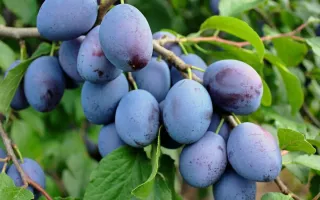
Fruits are round, above average size (mass 25-30 g), burgundy in color, with strong waxy coating, very attractive in appearance. Ripen early, in the first decade of August. Flesh is yellow-orange, juicy, tart-sweet, aromatic. Taste qualities of the fruits by organoleptic method are good, but the chemical composition is not rich enough: dry matter 14.6%, sugars 7.02%, acids 2.7%. Pit of medium size, flattened, poorly separates from the flesh.
Eurasia 21 is used for fresh consumption as an early-ripening table variety. In technological processing, it may be suitable for making very aromatic juice with pulp, jam.
The plant is self-sterile (pollen is nonviable). Best pollinators are varieties of domestic plum, whose flowering periods approximately coincide with those of Eurasia 21 (Record, Renklod Yarlyk, Mayak, Renklod Kolkhozny, etc.).
The tree begins fruiting on the 4th-5th year after planting. Under favorable conditions of pollination and fertilization, yield is high. In rainy and cold May, fruit set sharply decreases.
According to multi-year data, yield on three state variety trials (Krylovskoy, Pavlovskoy, Belgorodskoy) was: average — 257 centners per hectare, maximum — 403 centners per hectare, and in 1982 at Krylovskoy GUS, the yield of this variety reached 665 centners per hectare. Average yield per tree was 50 kg, maximum 80-100 kg.
The tree's winter hardiness, flower buds, and root system are high. Roots of Eurasia 21 can withstand temperature drops down to -20°C in the root zone, while roots of seedlings of domestic plum tolerate only -8-10°C.
Eurasia 21 is used not only as an early table variety, but also as a winter-hardy seed and partially budding rootstock. When green cuttings, rooting occurs at 60-70%. Trees of Eurasia 21 can also be used as good standards and framework-forming trees for plum varieties with damaged bark on standards.
In addition, the variety is an excellent donor in the breeding process. At VNIIGiSPR (formerly CGIL), Kursakov G.A. developed a whole group of varieties through crossing Eurasia 21 with domestic plum varieties — Etude, Zarichnaya, and others, developed into the regional variety assortment of Tambov Oblast.
Shortcoming of the variety: trees are very large (requires a dwarf rootstock); high acidity of fruits and somewhat loose flesh do not allow using fruits for making compotes.
Video · 6 videos
Suggest a video →Crop & resistance
Crop
Specifications
| Type of Sort | |
|---|---|
| Catalog | Catalog → Plum |
Not yet комментариев. Be the first!
Alternatives
Plum saplings · similar varieties



See also
Often considered together with this variety



Recently viewed
Products you’ve viewed on this site
Reviews · 0