


SKU #4212
·
339 views
Evening Bell
Plum
User rating
0 votes0% positive reviews
No ratings yet — be the first.
Type of Sort
Home Drain
Store offers · 3 from 3 stores
Prices are updated on loadLoading offers…
Available at: Лучший Сад · Саженцы и семена · Agromir
Aggregator catalog: prices are collected automatically from store websites, normalized by AI and converted at the current exchange rate. Before ordering, confirm the price and availability on the store's website. This block is not indexed by search engines — the data is loaded after the page opens.
About product

Introduced by P.P. Ivanov, E.V. Tyuzina, A.N. Minin at the Samara Regional Experimental Station for Horticulture through sowing seeds from open pollination of the 'Volzhskaya Krasavitsa' variety. Registered in the State Register in 2005 for the Middle Volga region. Medium-sized, fast-growing tree. Crown is broad-pyramidal. Fruits predominantly on bouquet branches and shoots. Shoots are thick, str…
Type of Sort
Home Drain
Description
Introduced by P.P. Ivanov, E.V. Tyuzina, A.N. Minin at the Samara Regional Experimental Station for Horticulture through sowing seeds from open pollination of the 'Volzhskaya Krasavitsa' variety. Registered in the State Register in 2005 for the Middle Volga region.
Medium-sized, fast-growing tree. Crown is broad-pyramidal. Fruits predominantly on bouquet branches and shoots. Shoots are thick, straight, dark-red, bare. Buds are few, medium-sized, white. Leaves are large, broad, egg-shaped, short-pointed, light-green, medium-creased, matte. Leaf tip is sharply pointed, base is rounded, pubescence is medium. Leaf margin is serrated-serrated. Petioles are medium, thin, pigmented. Stipules are medium, weakly divided, early falling. Petiole is medium length, thick, pigmented. Stipules are medium, two, pigmented. Flowers are double, solitary, rose-like, large, white.
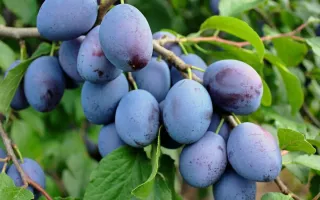
Fruits are large, one-dimensional, average weight 34.0 g. Fruit shape is oval-egg-shaped. Fruit apex is rounded, slightly depressed, wide and deep cavity. Fruit base has a depression, medium-depth cavity. Abdominal suture is medium-depth, prominent. Fruit stalk is medium length, thick, easy detachment from branch, weak attachment to pit. Fruit color is main red-violet, solid. Subcutaneous spots are medium quantity, white, clearly visible. Skin is medium, bare, with strong waxy coating, easily removed from fruit. Flesh is yellow-orange, tender, juicy, cavity color is single-color with flesh. Juice is colorless. Taste is sour-sweet. Pit separates easily from flesh, large, oval, pointed, in cavity. Fruit taste is 4.5 points. Fruit appearance attractiveness is 4.5 points. Fruits contain dry matter — 11.7%, sugars — 7.24%, acids — 2.39%, ascorbic acid — 5.72 mg/100g. Main use of fruits is dessert.
Flowering 11–20 May. Fruits ripen in medium term, 20 August — 3 September. Harvesting period is 20 August — 3 September. Fruit commercial quality is very high. Transportability of fruits in underripe state is good. Trees enter fruiting phase at 4–5 years. Fruit yield at 6–7 years age is 10–12 kg per tree, at 10–12 years — 25–30 kg and more. Annual fruiting. Fruits adhere well to tree, shed only upon overripening.
Variety is partially self-fertile. Best pollinators: 'Skorospelka Krasnaya', 'Miryana', 'Ternosilva Kuybyshevskaya', 'Viola'.
Variety is winter-hardy. Winter hardiness of tree is not lower than 'Skorospelka Krasnaya'. In severe winter 1986/87, bark burns, freezing of one-year shoots, 2–3-year branches and flower buds were observed. Overall degree of freezing was 1.5–2 points. Drought resistance is medium. Gum exudation is rare. In wet years, moniliosis affects up to 0.3%. Plum fruitworm affects up to 0.5%.
Propagated by grafting onto seedling rootstocks of 'Skorospelka Krasnaya', 'Ternosilva Kuybyshevskaya', 'Vengersky Oktyabrsky'. Requires sheltered from wind, well-drained sites. Responds well to complex mineral fertilizers with abundant yields. Young trees require shaping pruning. With age, crown becomes dense, therefore crown must be thinned by removing some branches.
Advantages of variety: high wood and flower bud winter hardiness, higher than 'Volzhskaya Krasavitsa', high yield, large, high-quality fruits.
Disadvantages of variety: fruit cracking in wet years and upon overripening.
Video · 1 video
Suggest a video →Crop & resistance
Crop
Disease resistance
Pest resistance
Specifications
| Type of Sort | |
|---|---|
| Catalog | Catalog → Plum |
Not yet комментариев. Be the first!
Alternatives
Plum saplings · similar varieties




See also
Often considered together with this variety


Recently viewed
Products you’ve viewed on this site
Reviews · 0