


SKU #4217
·
834 views
European plum Volga Beauty
Plum
Type of Variety
European plum
Your mark
0 votes
0% positive ratings
Store offers · 1 from 1 store
1 offer in 1 store — from 4.16 € per seedling.
Available at: Sadovaya Kollektsiya
Prices are collected automatically from store websites and converted at the current exchange rate. Check the price and availability on the store website before ordering.
Description
Developed by E.P. Finaev at the Kuibyshev Experimental Orchard for Fruit Growing in 1939 from crossing the varieties 'Sкороспелка красная' and 'Renklod Bawe'. Included in the State Register in 1965 for the Central, Middle Volga, and Lower Volga regions.
Large, fast-growing tree. The crown is spherical, slightly raised, of medium density. Bears fruit predominantly on bouquet branches. Bark on the trunk and main branches is smooth and gray. Shoots are thick and straight, bare. Few small, white buds. Leaves are large, broad, egg-shaped, short-pointed, light green, wrinkled, matte. Leaf blade is flat, sharply transitions to the tip; base is rounded, moderately hairy. Leaf margin is serrated-toothed. Petiole is medium, thick, pigmented. Bracteoles are medium, weakly incised, early falling. Stipules are medium, two, colored at the base of the blade or on the petiole. Inflorescence — double and triple flowers, large, white.
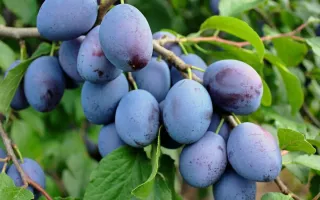
Fruits are large, one-dimensional, average weight 34 g. Fruit shape is oval-round, narrowing toward the base. Fruit apex is rounded, slightly depressed. Fruit base has an indentation, moderately deep and wide. Equatorial suture is medium depth, noticeable. Peduncle is medium, thick, good detachment from the branch, weak attachment to the pit. Fruit color is red-purple, blurred, solid. Subcutaneous dots: medium quantity, white, clearly visible. Skin is medium, bare, with strong waxy coating, easily removed. Flesh is yellow-orange, tender, juicy; cavity color is uniform with flesh. Juice is colorless. Taste character is sour-sweet. Pit detaches from flesh well, medium, oval, with pointed apex and base, in pits. Taste rating — 4.5 points. Fruit appearance — 4.8 points. Fruits contain dry matter — 22.0%, sugars — 10.35%, acids — 1.95%, ascorbic acid — 11.78 mg/100g. Primary use — dessert. Suitable for technical processing.
The variety is practically self-fertile. Best pollinators: 'Sкороспелка красная', 'Тернослива куйбышевская', 'Мирная', 'Жигули'.
Flowering: May 11–20. Fruit ripening is early. Harvesting period: August 10–25. Calendar consumption period: August 10–September 5. Transportability of fruits is medium. Trees begin fruiting at 4–5 years. Yield of fruits at ages 6–8 years — 8–10 kg, at ages 9–12 years — 12–25 kg. Annual fruiting. High-yielding variety. Good fruit attachment, better than 'Скороспелка красная'.
Cold resistance of trees is not lower than that of 'Скороспелка красная'. Flower buds are less cold-resistant than 'Скороспелка красная'. In the Middle Volga region, flower buds of 'Волжская красавица' often suffer damage, so good yields occur only in favorable years. Variety had average frost damage: at ages 5–8 years — 0.4 points; at ages 15–16 years — 1.0 points.
Not affected in dry years. Gum exudation is rare. Fruits are rarely affected by gray rot, mainly when damaged by cherry borer and plum fruit fly. Susceptibility to the latter is low — 0.5–1%.
Propagated by grafting onto seedling rootstocks of 'Скороспелка красная', 'Тернослива куйбышевская', 'Венгерка октябрьская'. Well propagated (up to 40%) by green cuttings. Requires well-protected, sunny, flat areas or gentle slopes. Grows well on medium- or light-loam chernozems, on marly clay, moderately moist sites. Responds significantly to watering and fertilization with increased yield and fruit quality. Can be shaped using single-tier or sparsely tiered systems, half-stem or low-stem forms. Tolerates pruning well.
Advantages of the variety: high annual yield, early fruiting, good winter hardiness, large size of attractive, delicious fruits.
Disadvantages of the variety: large tree size, insufficient cold resistance of flower buds, fruit cracking in wet years.
Video · 3 videos
Suggest a video →Crop & resistance
Crop
Disease resistance
Pest resistance
Specifications
| Type of Variety | |
|---|---|
| Catalog | Catalog → Plum |
No reviews yet. Be the first to share your experience.
Alternatives
Plum saplings · similar varieties


See also
Often considered together with this variety



Recently viewed
Products you’ve viewed on this site
Reviews