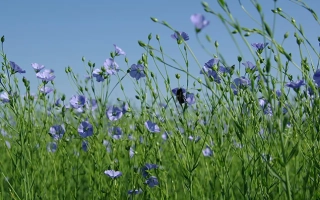
The flax variety 'Tomsk 17' is an early-ripening variety developed by the Siberian Federal Scientific Center of Agrobiotechnology of the Russian Academy of Sciences. It is recommended for cultivation in the North-Western, Central, and Western Siberian regions of Russia. The vegetation period of the variety ranges from 62 to 82 days, allowing for a quick harvest. The plants are characterized by good uniformity of stem number and maturity, light blue petals, and the absence of fringed false septum in the capsule.
The variety has a brown seed color.
'Tomsk 17' is distinguished by high yield: average straw yield reaches 36.4 centners per hectare, and seeds—4.4 centners per hectare. Fiber content in the plant varies from 24 to 32%, with a maximum value reaching 34%. Long fiber yield is 14 to 23%. The variety is resistant to lodging and shedding, which helps preserve the yield and facilitates harvesting. However, it is highly susceptible to Fusarium wilt, as well as susceptible to bacterial blight and rust, so protective treatments are necessary for successful cultivation.
Variety studies were conducted in various climatic conditions, including the sub-taiga zone of the Omsk region with heavy clay soil. Compared to other Tomsk breeding varieties, 'Tomsk 17' showed stable results in yield and fiber quality. Due to its characteristics and adaptability, the variety is popular among flax producers in Russia and holds leading positions in sowing volumes.