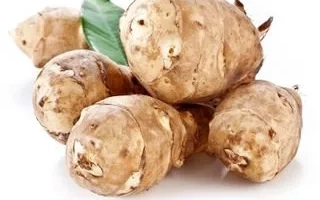
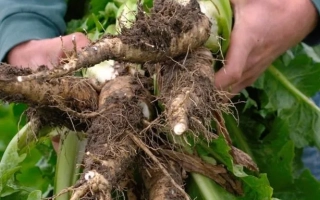
Horseradish "Valkovskiy" — a late-maturing variety of root crop, intended for cultivation in open ground. The root flesh is white and succulent, making it one of the best horseradish varieties widely used in culinary and canning applications. Besides the root, the plant’s leaves are also edible and used for medicinal purposes; they, together with the root, are rich in essential oils that impart a distinctive spiciness to dishes and possess antiseptic properties. Horseradish grows well both in full sun and in partial shade, making it convenient for cultivation on home plots.
This is a perennial plant from the Brassicaceae family, widely distributed in Ukraine and Russia. The root of horseradish "Valkovskiy" possesses pronounced antibacterial properties due to its high content of lysozyme — a substance capable of breaking down microbial walls and creating an antibacterial barrier in the body. Thanks to these qualities, horseradish is used not only in cooking but also in folk medicine as an expectorant, anti-inflammatory, antimicrobial, and analgesic agent. The medicinal raw material is the root, and fresh juice is rich in valuable bioactive substances.
Growing horseradish requires adherence to specific agronomic practices, including proper planting, propagation, and harvesting. For household needs, just a few plants are sufficient, as the plant is low-maintenance and does not require chemical treatments. However, it is important to control its spread to avoid excessive territorial occupation. Adhering to these rules allows obtaining a high-quality harvest that can be used both for food and medicinal purposes.