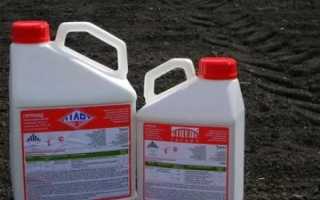
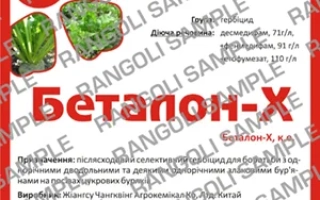
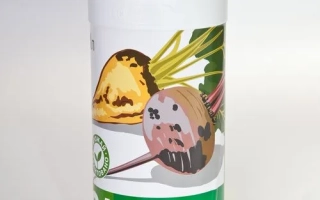
Oil-based emulsion concentrate. Efficiently eradicates nearly all broadleaf weeds and certain grassy weeds, regardless of soil-climate and weather conditions.
Spectrum of action: weeds — Ambrosia polyanthos, common burdock, species of Veronica, medicinal wormwood, blueweed, small-flowered Galinsoga, common mustard, field mustard, common nettle, common goosegrass, common henbane, common jimsonweed, common ragwort, stinging nettle, Russian cocklebur, field cornflower, broad-leaved dock, purple loosestrife, common chicory, common sunflower, common sow-thistle; common dandelion, dog fennel, sunflower hawkweed; less sensitive weeds: common chamomile, meadow foxtail, common mugwort, annual field pennycress, green mouse-ear, creeping bentgrass, bloodwort, gumweed, swine sorrel, sorghum.
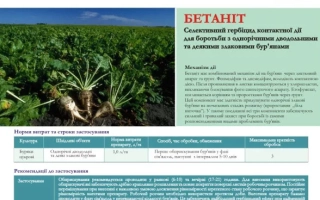
The herbicide's efficacy depends on weed species composition, their developmental stage, and application quality. When selecting application rates, consider the weed developmental stage. Maximum efficiency is achieved during the cotyledon stage in broadleaf weeds. Up to three applications may be conducted. For single application, the rate is 3 L/ha (sugar beet developmental stage — at least 4 true leaves). The working solution dosage is 200–250 L/ha, concentration should not be less than 0.4%.
Application must be conducted at temperatures not exceeding +25°C. The product is not applied under threat of night frosts, on weakened crops, or under strong sunlight. Best application is on dry, windless days, preferably in the evening or morning hours. For high efficacy, application should occur at least 5–6 hours before rain.
The well-chosen active ingredients of Betagard herbicide cause destructive and irreversible processes in weeds: disruption of photosynthesis, lipid synthesis, protein metabolism, cell growth and division inhibition, and prevention of waxy coating formation.
Betagard has a combined mode of action — through foliage and soil. Fenmedifam and desmedifam are mobile inhibitors of photosynthesis — they accumulate in chloroplasts after entering leaves and block the photosynthetic apparatus. Etofumate (germination inhibitor) is absorbed by various parts of plants — broadleaf weeds absorb it through roots, while monocots absorb it via coleoptile during germination.
Visual signs of herbicide action — leaf color lightening and, subsequently, chlorosis — appear 2–7 days after application. Complete weed death occurs within 2–3 weeks.
One of the active ingredients, etofumate, is absorbed by young weed shoots when they contact the soil solution containing etofumate. Thus, higher soil moisture enhances etofumate efficacy, while drought and high organic matter content in soil reduce it.
Application specifics:
Sugar beet crops are treated with the product during the first, second, and third weed waves with 10–12 day intervals. Efficacy depends on following application rate recommendations relative to weed developmental stages. Maximum efficiency is achieved before the cotyledon stage in broadleaf weeds and the spikelet stage in grassy weeds.
Optimal conditions for Betagard herbicide application — temperature from +10°C to +25°C and absence of strong sunlight.
Application restrictions:
Spraying sugar beets is not recommended on wet plants from rain or dew, when weeds are under stress (weakened by cultivation, heat, frost, disease, or pests), or less than 6 hours before rainfall.
To avoid plant burn risk, avoid application before the appearance of two true leaves of the crop.
Toxicity: Class III (moderately hazardous). Low toxicity to mammals. Non-toxic to bees. Toxic to fish.
Store the product in specialized pesticide storage facilities at temperatures from 0°C to +30°C.